Heating · Lexington, KY
Electric furnace repair in Lexington when the heat strips fail
Your electric furnace runs but the air coming out is barely warm, a breaker keeps tripping, or nothing happens at all, and the house is cooling down fast.
Lexington and nearby counties
Line open 24/7Short answer: Electric Furnace Repair in Lexington, KY
When an electric furnace stops heating, check the thermostat mode, then the two or more large double-pole breakers that feed it, and reset a tripped one only once. If air blows but feels cool, one or more heat strips, sequencers or limit switches has usually failed. A breaker that trips again, a burning smell or melted wiring means turn it off and call for repair.
Steps to take while the house is cooling down
Electric furnaces carry high current, often 60 to 100 amps. Stay on the outside of the cabinet and use only these checks.
- Set the thermostat to heat and a few degrees above room temperature.
- Check the furnace filter; a clogged one can trip the strip heat limits.
- At the panel, find the furnace breakers, often two or three large double-pole ones.
- Reset a tripped breaker one time, then leave it off if it trips again.
- Feel the supply registers after five minutes to see if the air is warming.
- Turn the furnace off at the breaker if you smell hot plastic or see scorching.
- Use space heaters only on their own outlets, away from bedding and curtains.
Why electric furnaces blow cool or shut down
An electric furnace is a blower and a set of resistance heaters with switches between them. Here is what breaks.
Burned-open heat strip
Each heating element is a coil of nichrome wire. When a coil breaks, that stage gives no heat, so the furnace runs with partial output and the air feels lukewarm.
Failed sequencer
Sequencers bring each strip on in turn so the house does not see a huge current spike. A sequencer that sticks open leaves strips off, and one that sticks closed can overheat them.
Open limit or thermal fuse
Each element has a limit switch and often a one-time thermal fuse. Weak airflow trips the limit repeatedly, and eventually the fuse opens and the strip stays dead.
Blower not moving air
A failed blower motor, weak capacitor or loose wheel lets the strips overheat within seconds. The limits shut them down, and you get noise but no heat.
Loose or burned lugs
High current through a loose connection heats the lug, darkens the wire and can melt insulation. We find these by temperature and by eye, then cut back and reterminate.
Transformer or control fault
A blown 24-volt fuse or failed transformer stops all heat. Often the cause is a chafed thermostat wire shorting against the cabinet.
What happens when our technician opens the cabinet
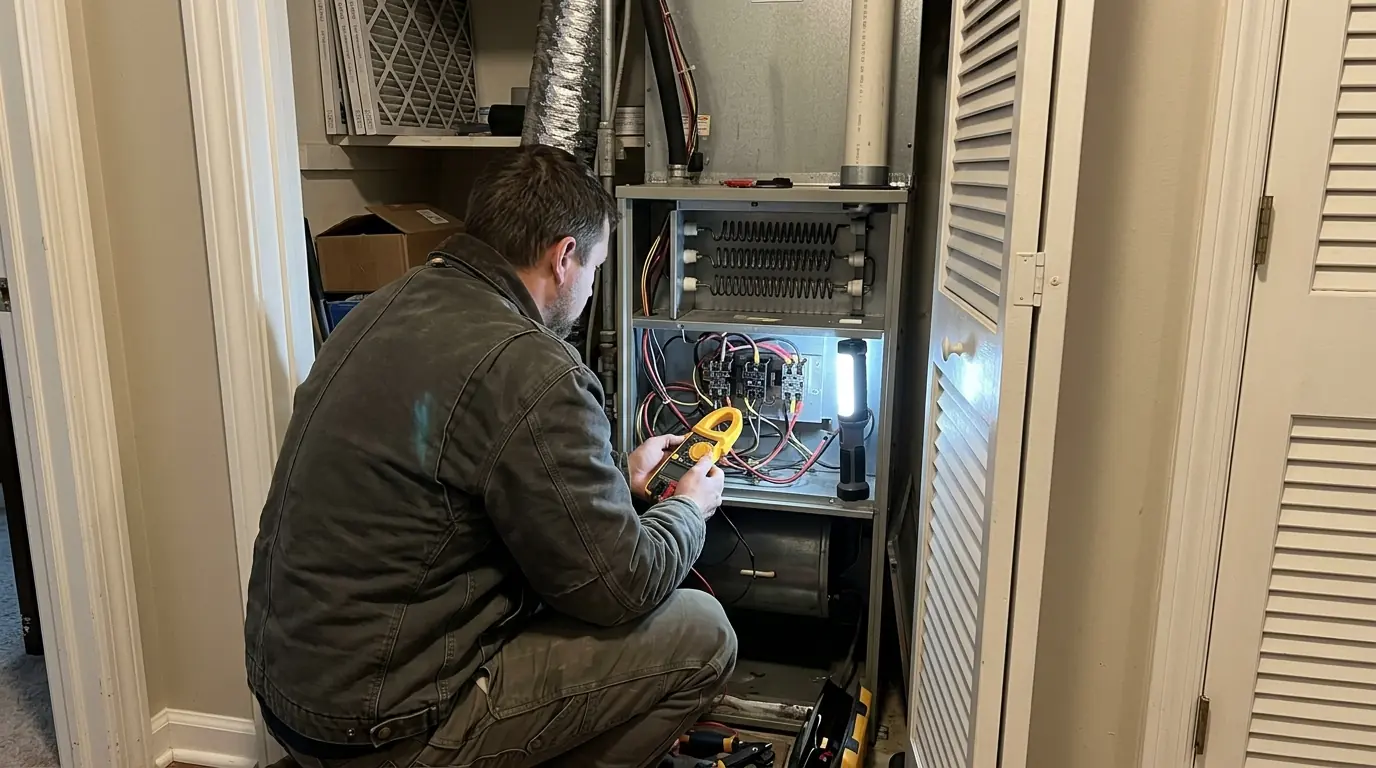
Electric furnace diagnosis is all measurement. We test each stage under load and show you which part failed.
Lock out and inspect
We shut off the breakers, verify with a meter that power is off, and inspect wiring, lugs and strips for scorching, melted insulation or broken coils.
Measure each element
Each heat strip is checked for resistance. A typical 5 kW element reads around 11 to 12 ohms at 240 volts, and an open reading means a broken coil.
Run it and read amps
With power back on, we clamp each circuit and watch the strips come on in sequence. Amp draw tells us how many kilowatts are really heating.
Check airflow
We measure temperature rise and static pressure. Too little air is the most common reason electric furnaces keep tripping limits.
Repair and confirm
Failed parts are replaced, connections tightened to torque, and the furnace run through full cycles until the supply air and amp draw read correctly.
Electric furnace repair costs in central Kentucky
Most electric furnace repairs we complete fall inside this range. Single limits and fuses sit low, while multiple strips or a blower motor reach higher.
- Number of failed stages. One open element or limit is a modest repair, while a heater kit with several burned strips may need a full replacement assembly.
- Burned wiring. When a loose lug has cooked the wire, we cut back to clean copper and may replace a section of wire or a terminal block.
- Blower motor type. A standard PSC motor costs much less than a variable-speed ECM motor, which some newer electric air handlers use.
- Furnace location. Closet and garage units are easy to reach, while attic and crawlspace air handlers take longer to work on safely.
- Airflow fixes. If a crushed duct or undersized return is causing repeated limit trips, correcting it is priced as its own line.
These are typical ranges, not quotes. Your written price comes after we look at the system and measure each stage. Compare typical prices for every service.
All-electric homes and KU winter bills in Lexington
Electric furnaces are common across central Kentucky where gas lines never reached: rural lots in the surrounding counties, many manufactured homes, condos and apartments, and some 1970s and 1980s houses built during the all-electric push. In Lexington and nearby towns, KU supplies that power, and when a cold snap pushes nights into the single digits, an electric furnace running full strip heat draws a lot of it. Even one failed strip shows up as a house that cannot keep up.
Partial failures are easy to miss. A 15 kW furnace with one dead 5 kW element still makes warm air, just not enough, so the furnace runs nonstop and the bill climbs while the house drifts down. If your KU bill jumped and the house still feels cool, we measure the amp draw to see how much heat you are really getting.
Many all-electric homes also have an older heat pump with strip heat as backup. If that applies to you, read our AUX and emergency heat explainer, because a failed heat pump forces strips to carry the whole load. Replacing a straight electric furnace with a heat pump installation often cuts winter heating costs sharply.
Heat strip size and how much heat you lose
Most residential electric furnaces use 5 kW elements. This shows what losing one element means at different furnace sizes.
| Furnace size | Elements | Heat left with one failed |
|---|---|---|
| 10 kW | Two 5 kW | About half |
| 15 kW | Three 5 kW | About two thirds |
| 20 kW | Four 5 kW | About three quarters |
| 25 kW | Five 5 kW | About four fifths |
We work on Carrier, Trane, Lennox, Rheem and Goodman equipment along with every other major brand found in Lexington homes, and the same testing comes first on all of them.
Neighborhoods and towns that call us for electric furnace repair
We cover every Lexington neighborhood and the towns around it. These are the places we visit most for this work; the full list is on our Fayette County page and the service area page.
Questions about electric furnace repair in Lexington
Why does my electric furnace blow air that is only lukewarm?
Lukewarm air usually means some of the heat strips are not coming on. A broken element, an open limit or thermal fuse, or a failed sequencer can each knock out one stage while the rest keep running. Low airflow from a dirty filter can cause limits to cycle the strips off as well. We measure each stage to find which one dropped out.
Is it dangerous when an electric furnace keeps tripping the breaker?
It can be. A breaker that trips again right after a reset is telling you there is a short, a failed element touching the frame, or a connection overheating. Leave it off. Resetting it repeatedly can damage wiring and the breaker itself. Call (859) 377-8167 and use safe space heating until we test the circuit.
How long do electric furnace heat strips last in a Kentucky home?
Heat strips often last 15 years or more when airflow stays strong. Dirty filters, closed registers and failing blowers shorten that life, because the elements overheat and the limits cycle constantly. Homes that rely on strip heat for every cold night wear elements faster than homes where a heat pump carries most of the load.
Can a burning smell from an electric furnace be normal?
A light dusty smell for the first few minutes of the season is normal as dust burns off the elements. A sharp hot plastic or electrical smell is not: it can mean melting wire insulation or an overheated connection. Turn the furnace off at the breaker and call. Our guide to furnace smells explains the difference.
Should I repair or replace an old electric furnace in Lexington?
If the cabinet, blower and wiring are sound, replacing a failed element or sequencer is usually the cheaper and faster choice. Replacement starts to make sense when the furnace is past 20 years, several strips and the blower have failed, or KU bills are high every winter. In that case a heat pump with the electric strips kept as backup often lowers running costs.
Call and describe what the system is doing
A person answers (859) 377-8167 day and night. Tell us what you are seeing and a technician takes it from there.