Emergency & Projects · Lexington, KY
Gas line installation and repair for Lexington homes
You're adding a gas range, dryer, generator or fireplace, replacing a furnace, or you've found rusty pipe and an old flexible connector behind an appliance, and you want the house piping done right and tested.
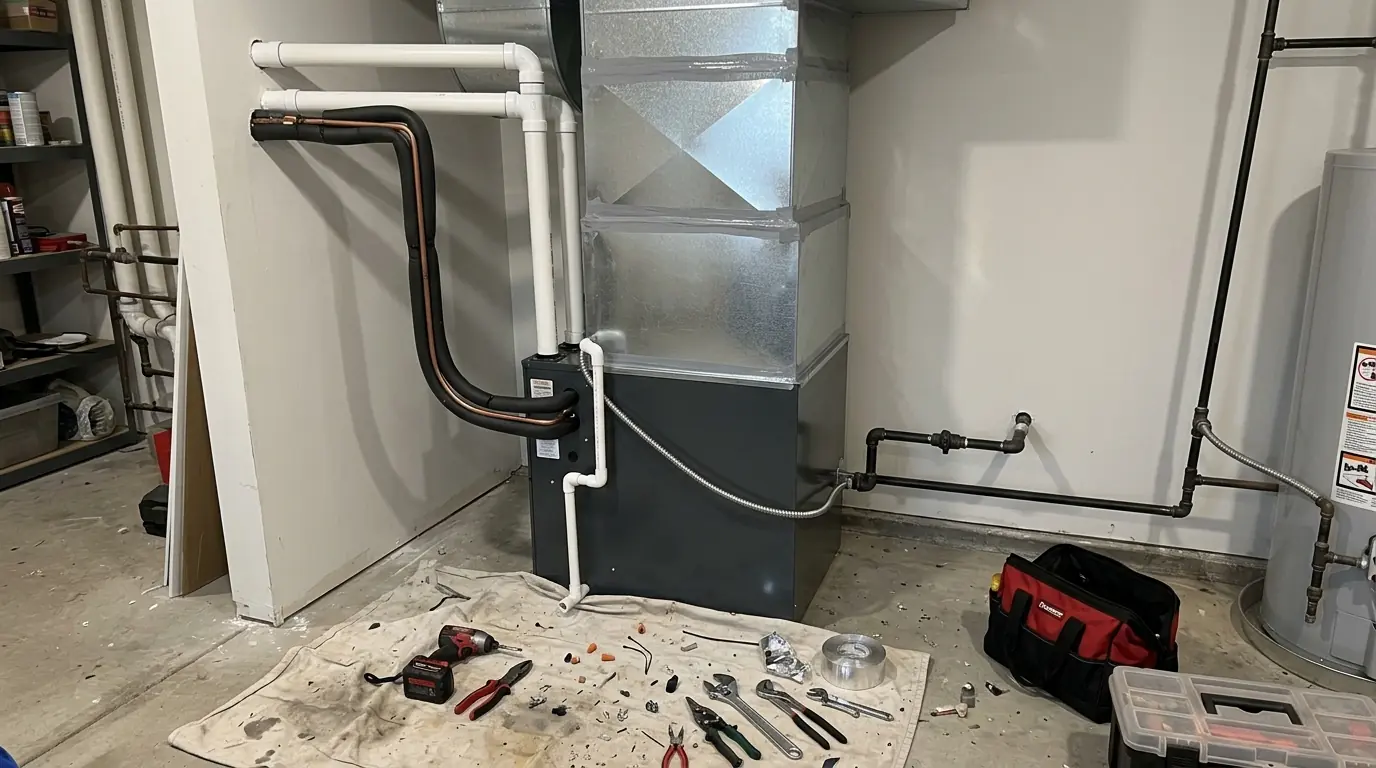
Lexington and nearby counties
Line open 24/7Short answer: Gas Line Installation & Repair in Lexington, KY
A new gas line runs from your existing house piping, after the Columbia Gas meter, to the new appliance, sized for its BTU load and every other appliance on the system. A proper job adds a shutoff valve and a sediment trap, is pressure tested before gas goes in, and is leak checked at every joint. If you ever smell gas, leave the house first and call Columbia Gas or 911 from outside.
Smell gas? Leave first, then phone from outside
Gas carries an added rotten egg odor so leaks get noticed. Indoors, emergency responders and the gas company come before any heating contractor.
- Get everyone, pets included, out of the house right away.
- Do not flip switches, unplug anything, use a phone inside or start a car in an attached garage.
- Leave the door open behind you if it is on your way out.
- From outside and well away from the house, call Columbia Gas of Kentucky's emergency line or 911.
- On propane, close the tank valve only if you can reach it safely, then call your propane supplier.
- Stay out until the gas company or fire department says the house is safe.
- Once the house is safe, call (859) 377-8167 to repair the leak in your house piping.
Where Columbia Gas stops and your house piping starts
In Lexington, Columbia Gas of Kentucky owns the gas meter and the service line that runs to it. Problems with the meter, the regulator beside it, the service line in the yard, or an outage on your street are theirs to handle, and they are the first call for any leak. Everything downstream of the meter outlet, the house piping that runs to each appliance, is where our work happens.
That house piping is a small system of its own. It has to carry the gas every appliance could use at the same moment, at the low pressure most homes run on, about a quarter of a pound per square inch. A large new load such as a standby generator or a tankless water heater can outgrow pipe that was sized for a furnace and a tank water heater years ago. When the total climbs, the utility decides whether the meter needs upsizing, and we tell you early if your numbers point that way.
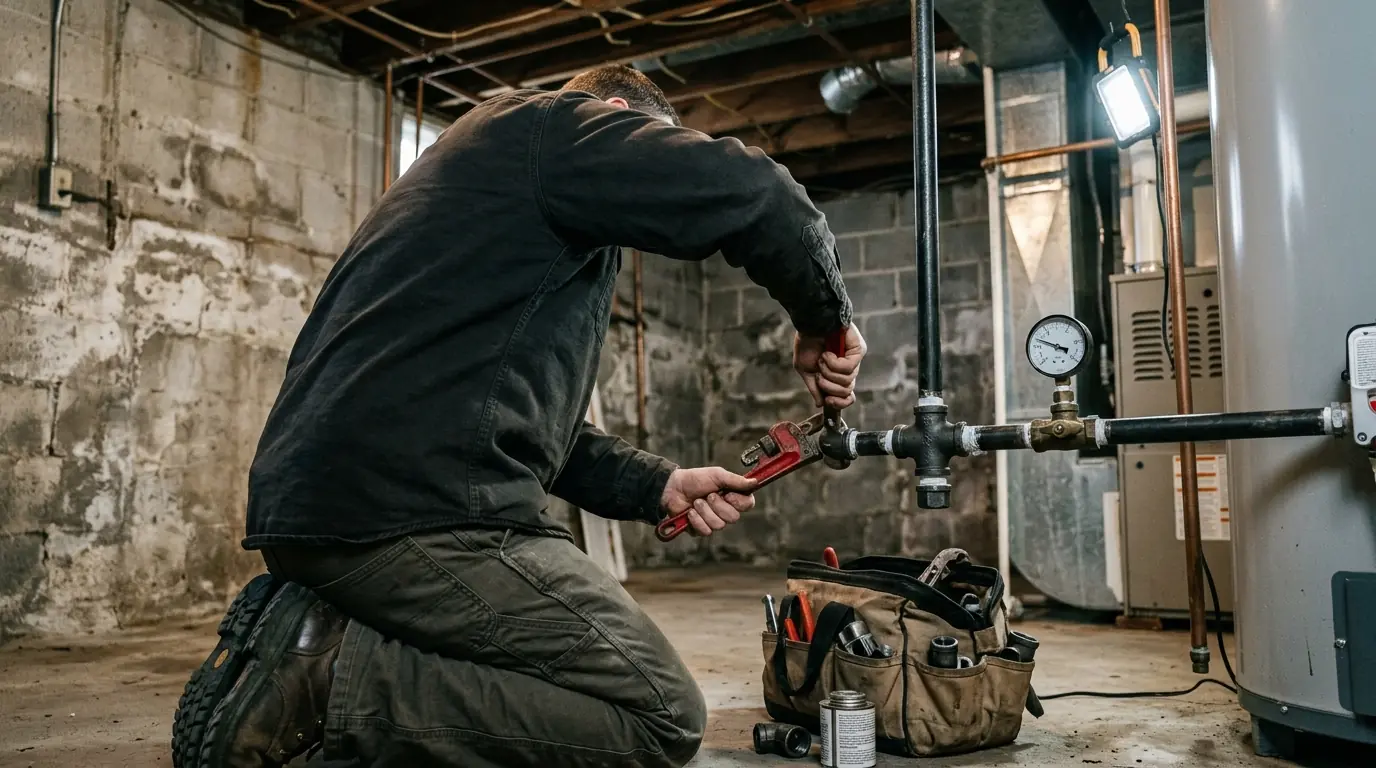
Appliances we pipe gas to most often
Most of our gas line work comes with a new appliance, or with a replacement that moves to a new spot in the house.
Furnaces and boilers
A high-efficiency unit often lands in a slightly different spot and needs a new drip leg and shutoff. Our furnace installation work includes checking that the line is large enough.
Ranges and cooktops
Switching a kitchen from electric to gas means a new line through the floor or wall, a shutoff behind the range and a new coated connector.
Dryers and water heaters
Gas dryers and tank or tankless water heaters each need the right pipe size, and tankless units often need a far larger line than the tank they replace.
Fireplaces and gas logs
Inserts and log sets need a shutoff or key valve near the hearth and a line sized for the burner, often run through a basement or crawlspace.
Standby generators
Whole-house generators burn a lot of gas at full load. We size a dedicated line from the meter, usually run underground to a pad beside the house.
Grills, fire pits and patio heaters
Outdoor appliances get a buried or wall-run line with an outdoor shutoff and a quick-disconnect, so you never swap a propane cylinder again.
Black iron, CSST and flexible connectors compared
Different piping materials suit different parts of the job, and most houses end up with a mix of them.
| Material | Where we use it | What to know |
|---|---|---|
| Black iron pipe | Basements, exposed runs and main trunks | Durable, but rusts in damp crawlspaces if left bare |
| CSST flexible tubing | Long runs through finished walls and attics | Fewer joints; needs bonding per the tubing maker |
| Coated appliance connectors | The last few feet from shutoff to appliance | Replace old uncoated brass; never reuse one |
| Polyethylene gas pipe | Underground runs to generators, grills and shops | Buried only, with tracer wire and steel risers |
Warning signs in older gas piping and connectors
We spot these on furnace and dryer visits all the time. None is an emergency unless you smell gas, but each one deserves a fix.
Uncoated brass connectors
Older bare brass flex lines behind ranges, dryers and water heaters can crack at the flare fittings. We replace them with coated connectors and new shutoffs.
Rust and flaking on pipe
Black iron in a damp crawlspace rusts from the outside in. Light surface rust gets cleaned and painted; deep pitting means that section gets replaced.
Open or abandoned branches
Old lines from a removed range, heater or gas light sometimes end at a loose valve. We cut them back to the trunk and cap them properly.
Kinked connector behind the dryer
Pushing a dryer tight against the wall can kink or crush its connector. A kink strains the fittings and can starve the burner of gas.
A faint odor at one appliance
A slight smell at one spot often means a weeping fitting. If the odor is strong or spreading, leave the house and call from outside first.
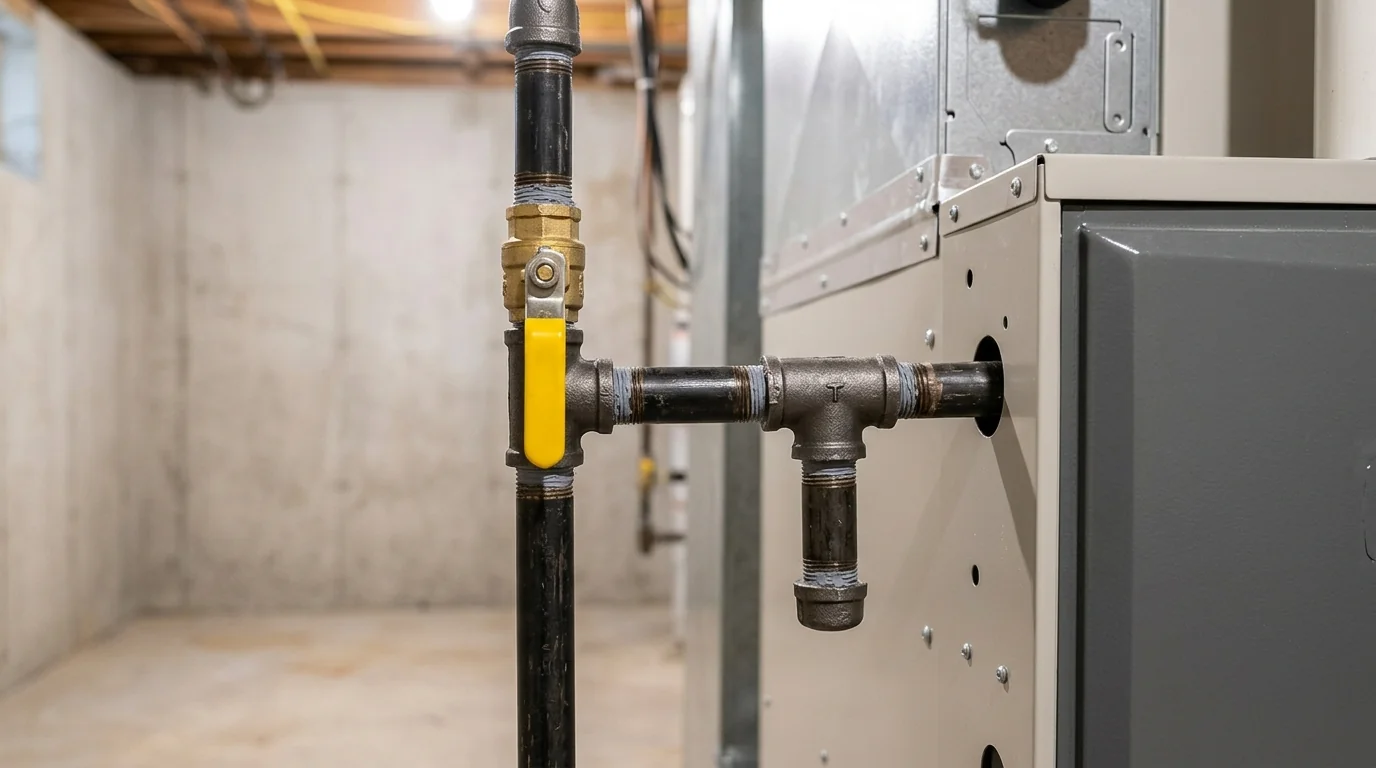
How a new gas line goes in, from meter to burner
Every new line follows the same sequence, whether it feeds a cooktop in the kitchen or a generator in the side yard.
Add up the load
We list every gas appliance with its BTU rating and measure pipe lengths, so the new line and the existing trunk can carry everything at once.
Plan the route
We pick the shortest sensible path through the basement, crawlspace, walls or yard, and have underground utilities marked before any digging.
Install pipe, shutoff and drip leg
The new piping goes in with proper supports, a shutoff valve within reach of the appliance and a sediment trap ahead of its gas valve.
Pressure test the new section
Before gas goes in, the new piping is capped, pumped up with air above its working pressure and held on a gauge to prove it is tight.
Purge, connect and leak check
We open the gas, purge air from the line, connect the appliance, and check every joint with leak solution and an electronic detector.
Light and measure
The appliance is lit, inlet gas pressure is read with a manometer, and the burner flame is checked before we leave.
Typical 2026 prices for new gas piping
Most gas line jobs in Lexington homes land in this range, from a connector and shutoff swap up to a long generator line.
- Length and route. A short run off a basement trunk to a dryer costs far less than a line through finished walls or across a crawlspace to the far end of the house.
- Pipe size. Generators and tankless water heaters need larger pipe, and sometimes a new trunk back toward the meter.
- Underground work. Trenching to a grill, generator or detached shop adds time, and limestone near the surface can slow the digging.
- Condition of existing piping. Rusted pipe, old connectors or open branches found along the way may need fixing before a new load is added.
These are typical ranges. Your written price comes after we look at your existing piping, measure the run and total up the appliance load. Compare typical prices for every service.
Aging pipe, rocky yards and propane across the Bluegrass
Gas piping in a Lexington house often tells the story of the house. In older neighborhoods near downtown, such as Chevy Chase, Bell Court and Kenwick, many homes moved to gas from coal or oil and picked up new pipe with every kitchen and furnace change. We regularly find capped branches from old ranges, threaded pipe from several eras joined together, and a trunk too small for the appliances in the house today.
Homes built over crawlspaces have their own pattern. Humid summers keep crawlspace air damp, and bare steel pipe slowly rusts down there. Newer subdivisions lean on CSST in basements and attics, which needs its bonding left intact. Outside, the limestone under much of Fayette County can sit just below the topsoil, so a simple trench for a grill or generator line turns into careful, slower work.
Spring storms and winter ice push plenty of homeowners toward standby generators, the biggest gas users most houses will ever add. On farms in Woodford County and the other rural counties around town, propane takes the place of natural gas. Your propane supplier sets and fills the tank, and we run lines from their connection to the house, barn or shop. When the line feeds a shop heater, our page on garage and shop heaters covers the heater side.
We work on Carrier, Trane, Lennox, Rheem and Goodman equipment along with every other major brand found in Lexington homes, and the same testing comes first on all of them.
Where we handle gas line installation & repair most often
We cover every Lexington neighborhood and the towns around it. These are the places we visit most for this work; the full list is on our Fayette County page and the service area page.
Questions about gas line installation & repair in Lexington
Can you run a gas line for a new range in a Lexington kitchen?
Yes. Most kitchens near an existing gas trunk in the basement or crawlspace can get a new range line in a few hours. We tap the trunk with a properly sized branch, bring it up through the floor behind the range, add a shutoff valve you can reach with the range pulled out, and connect with a new coated connector. Then we pressure test, leak check and light every burner.
Who fixes a gas leak at the meter versus a leak inside the house?
A leak at the meter, its regulator or the service line in the yard belongs to Columbia Gas of Kentucky. A leak on the house side of the meter, at a fitting, valve, connector or appliance, is in the homeowner's piping. Either way, if you smell gas, leave and call Columbia Gas or 911 from outside first. After the utility makes it safe, we find and repair house-side leaks.
How big does a gas line to a standby generator need to be?
It depends on the generator's BTU rating at full load and the distance from the meter. A whole-house standby unit can burn 250,000 BTU per hour or more, more than a furnace, range and water heater combined, so it often needs its own 1-inch or larger line rather than a tee off existing pipe. We size it from the generator's spec sheet and the measured run.
Should an old uncoated flexible gas connector be replaced?
Yes. Uncoated brass connectors from older installs can crack or pull apart at the flare nuts, especially after an appliance has been moved a few times. If the connector behind your range, dryer or water heater is bare gold-colored metal with no coating, have it replaced with a new coated connector and a fresh shutoff valve. Connectors should never be reused when an appliance is swapped.
Can a propane line be run underground to a detached shop or barn?
Yes. We run polyethylene gas pipe underground with a tracer wire so it can be found later, then transition to steel risers where it comes up at the house and the building. Propane runs at a higher pressure than natural gas, so the line is sized for that pressure and the heater's load. Rocky Bluegrass ground sometimes changes the route, so we walk it first.
Need gas line installation & repair today?
A person answers (859) 377-8167 day and night. Tell us what you are seeing and a technician takes it from there.