Heating · Lexington, KY
Radiant floor heating in Lexington, from cold loops to new floors
Part of your heated floor stays cold, the manifold gurgles, or you're planning a basement, addition or bathroom and want warmth that rises through the floor instead of blowing out of a vent.
Lexington and nearby counties
Line open 24/7Short answer: Radiant Floor Heating in Lexington, KY
Radiant floor heating warms a room through the floor, either with hot water moving through PEX tubing or with electric mats under tile. When a hydronic floor stays cold, the usual causes are a failed circulator, a stuck mixing or zone valve, a dead manifold actuator or air trapped in the loops. New installs around Lexington run about $1,140 for a bathroom mat to $17,860 for a large basement with a new heat source.
Why a warm floor feels different from warm air
Forced air heats the air and pushes it around the room, so warmth gathers near the ceiling and fades each time the blower stops. A radiant floor works the other way. The whole floor becomes a low, steady heat source, usually 75 to 85 degrees at the surface, and it warms your feet, the furniture and anyone standing on it. Most people feel comfortable with the thermostat set a degree or two lower.
The tradeoff is speed. A concrete slab with tubing in it stores a lot of heat, so it changes temperature over hours, not minutes. Deep night setbacks rarely pay off on a slab. Staple-up floors and electric mats respond faster, which is one reason we match the method to the room.
Slab tubing, staple-up, panels and electric mats compared
Four common ways to heat a floor, depending on whether it is new, remodeled or staying in place.
| Method | Where it fits | What to know |
|---|---|---|
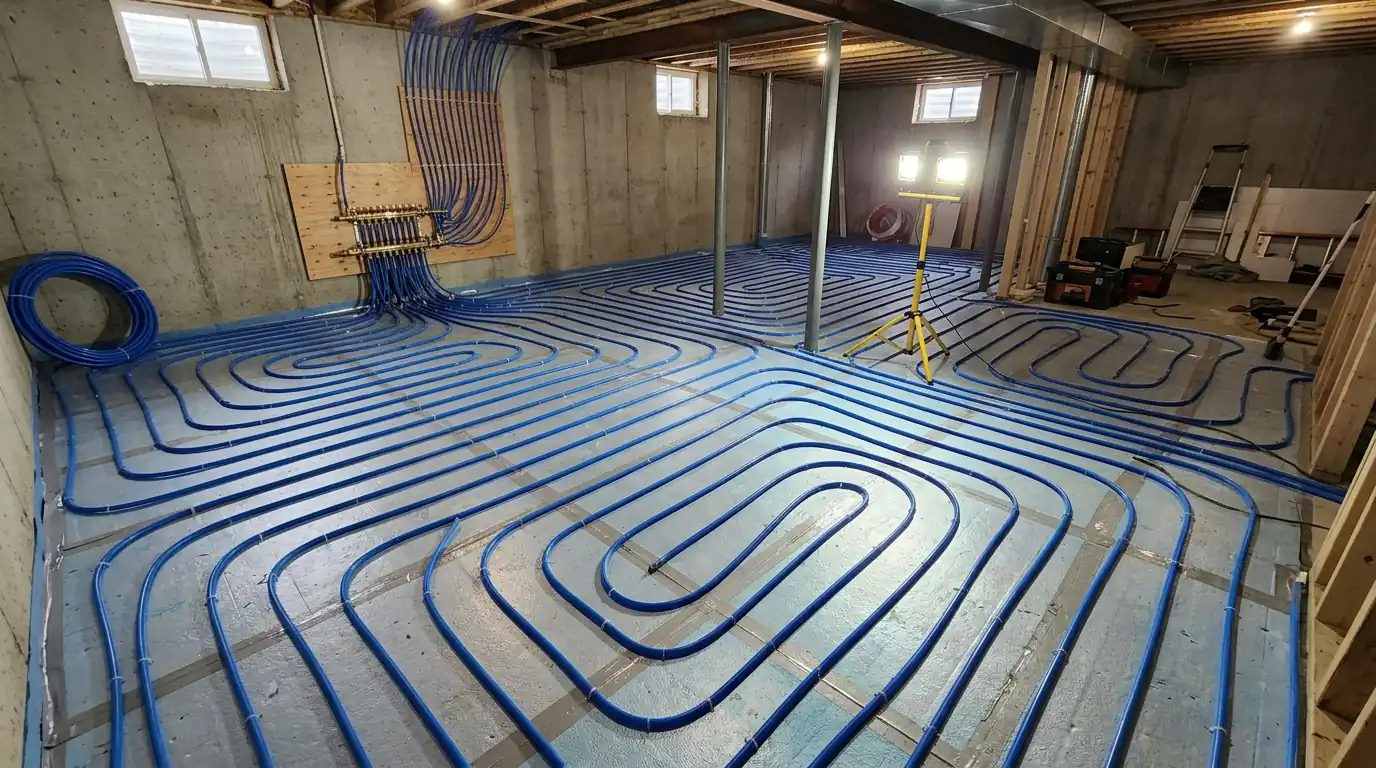
| PEX tubing in a slab | New basements, additions and slab homes | Laid over foam board before the pour |
| Staple-up under the subfloor | Wood floors with open framing below | Aluminum plates and insulation push heat upward |
| Grooved low-profile panels | Remodels that can raise the floor slightly | Tubing snaps into panels under tile or wood |
| Electric mats or cable | Bathrooms, kitchens and small tiled rooms | No boiler; a floor-sensing thermostat runs it |
Faults behind a radiant zone that stays cool
Hydronic floors have few moving parts, and nearly every no-heat call we take on one traces back to something on this list.
Circulator not moving water
The boiler or water heater fires, but the floor never warms because the pump has seized, lost its capacitor or burned out. Older wet-rotor pumps often stick after sitting idle all summer.
Mixing valve stuck or scaled
Boilers make water too hot for a floor, so a mixing valve tempers it. When that valve sticks, the floor runs lukewarm or too hot, and hard water speeds up the scale.
Manifold actuator burned out
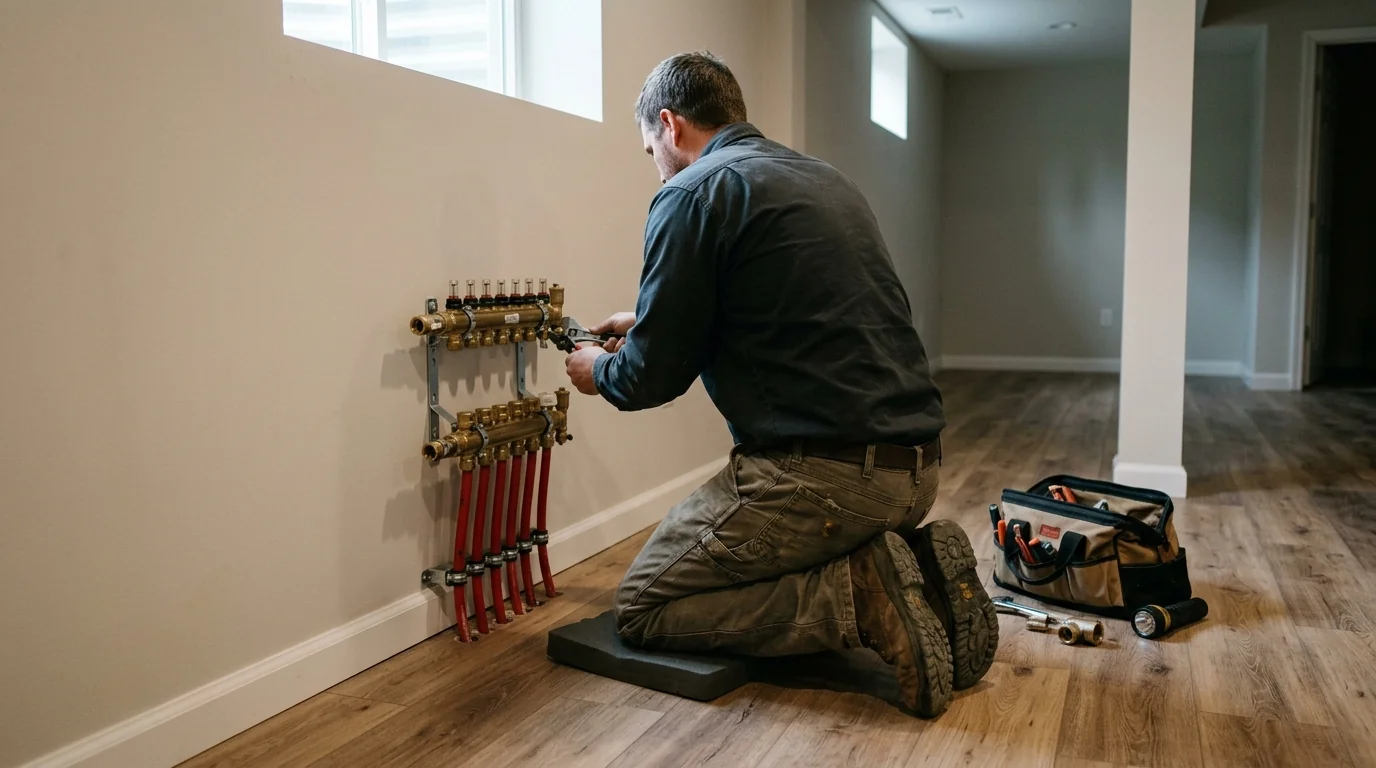
Each loop at the manifold may carry a small electric actuator that opens when its room calls. A dead actuator leaves one room cold while the rest of the floor heats normally.
Air trapped in the loops
Air collects in high spots and blocks flow, especially after a repair or a slow leak. You may hear gurgling at the manifold while one or two loops stay cold.
Electric mat sensor or trip
Electric floors usually stop when the thermostat's built-in ground fault protection trips or the floor sensor fails. A damaged heating wire is rarer and shows up on a resistance test.
Quick checks when a heated floor goes cold
These are safe for any homeowner. If something looks wrong, call (859) 377-8167 and tell us what you found so we bring the right parts.
- Confirm the room thermostat is calling for heat and set above room temperature.
- On floor-sensing thermostats, make sure the floor limit was not turned down.
- Reset an electric floor thermostat once if its fault light shows; repeat trips need a visit.
- Read the boiler pressure gauge: most closed radiant systems sit near 12 to 15 psi.
- Touch the manifold pipes: a hot supply and a cold return points to a flow problem.
- Look for water stains under staple-up tubing or around the manifold fittings.
- Never crank the mixing valve all the way up; hot water can damage flooring.
Planning a radiant floor for a basement, addition or bath
A new radiant floor is mostly planning. Once the heat loss, layout and heat source are settled, the tubing goes in quickly.
Measure the room's heat loss
We calculate how much heat the space loses on a cold January night. That number sets tube spacing, water temperature and whether the floor can carry the room alone.
Pick the heat source
A boiler with spare capacity, a new combi boiler or a high-efficiency water heater with a plate heat exchanger can each feed the floor. Electric mats skip this step.
Lay out loops and the manifold
Loops stay within lengths the pump can push, run tighter along exterior walls and doors, and return to a manifold placed where you can reach it later.
Pressure test before covering
The tubing is held under pressure while the concrete is poured or the flooring goes down, so any nick or kink shows up right away instead of after the tile is set.
Fill, purge and set temperatures
We purge each loop of air one at a time, set the mixing valve or outdoor reset for your floor covering, and confirm every loop warms evenly.
Show you the controls
Thermostats and floor sensors go in last. We walk you through the manifold, the purge valves and what normal pressure and temperature readings look like.
Radiant floor repair prices in central Kentucky
Most radiant repairs happen at the mechanical end, near the boiler and manifold, which keeps them inside this range.
- Which part failed. A manifold actuator or air vent sits at the low end, while a circulator, motorized mixing valve or boiler control moves toward the top.
- Purging and glycol. Any repair that opens the loop means refilling and purging every loop. Floors in garages or seldom-heated rooms may also carry glycol that has to be restored.
- Tubing without oxygen barrier. Older tubing without an oxygen barrier lets air in and rusts iron parts, so replacement pumps and valves may need to be bronze or stainless.
- Leaks under a finished floor. A leak inside a slab or under flooring is located first with a thermal camera, and that repair is priced on its own once we see where it is.
These are typical 2026 ranges. Your written price comes after we look at the system, test it and show you which part failed. Compare typical prices for every service.
What a new radiant floor install costs in 2026
Floor size and the heat source drive most of an install price.
- Electric mat or hydronic. A bathroom electric mat under new tile sits near the low end. Hydronic floors cost more up front but cost less to run on natural gas in large spaces.
- Square footage and spacing. More floor and tighter tube spacing mean more tubing, more loops and a bigger manifold with more ports.
- Heat source. Tying into a boiler with spare capacity costs far less than adding a new combi boiler or a dedicated water heater with a heat exchanger.
- Floor method. Tubing in a new slab is the cheapest per square foot, while staple-up and grooved panels add plates, panels and labor in finished spaces.
- Zones and controls. Each separately controlled room adds an actuator or zone valve, a thermostat and wiring. An outdoor reset control adds a little more.
Ranges assume normal access. Your written price comes after we measure the space, check the heat source and agree on a layout with you. Compare typical prices for every service.
Limestone slabs, finished basements and warm floors in Lexington
Much of the radiant work we do in Lexington starts in a basement. Two-story homes in Hartland and other subdivisions from the 1980s through the 2000s often have finished lower levels on a slab poured over limestone ground, and those floors feel cool even in a well-heated house. Most older basement slabs have no foam underneath, so they lose heat downward. For an existing slab, we usually look at low-profile panels over the concrete rather than heating the slab itself.
In older houses near downtown, in Chevy Chase, Ashland Park and Bell Court, a radiant floor often arrives with a kitchen remodel or a rear addition on a house that still heats with a Columbia Gas boiler. If that boiler has spare capacity, a mixing valve and a new zone can feed the floor without a second heat source. If it is near the end of its life, our boiler replacement options include combi units that heat both the floor and the showers.
Radiant floors only heat. Muggy Lexington summers still call for cooling and moisture control, and homes heated through the floor usually pair it with ductless mini split heads or a compact central air system. Electric bathroom mats run on KU power and cost little to operate, because they warm only the few square feet under your feet.
We work on Carrier, Trane, Lennox, Rheem and Goodman equipment along with every other major brand found in Lexington homes, and the same testing comes first on all of them.
Where we handle radiant floor heating most often
We cover every Lexington neighborhood and the towns around it. These are the places we visit most for this work; the full list is on our Fayette County page and the service area page.
Common questions on radiant floor heating around Lexington
Can radiant floor heating run off a water heater instead of a boiler?
Yes, for smaller floors. A high-efficiency gas water heater or a combi boiler can heat both your showers and a radiant floor if it has the capacity for both loads. We keep the floor water separate from drinking water with a plate heat exchanger, so stale water from the loops never reaches a faucet. Large basements or whole-house floors usually need a dedicated boiler.
How long does a radiant slab take to warm up after being off?
A concrete slab with tubing in it is heavy, so it moves slowly. Expect several hours before you feel a change and most of a day to fully recover after a long shutdown in cold weather. That is why we set slab floors to hold a steady temperature instead of dropping at night. Staple-up floors and electric mats respond faster, often within an hour.
Can radiant floor heating go under hardwood or carpet?
It can, with limits. Engineered hardwood handles radiant heat better than wide solid boards, and most flooring makers cap the surface temperature, often around 80 to 85 degrees. Thick carpet and heavy pads act like a blanket and cut heat output, so a carpeted room may need closer tube spacing or a little extra heat. We set the mixing temperature to match the covering you choose.
Why does my radiant floor manifold gurgle or hiss?
Gurgling at a radiant manifold almost always means air in the loops. It can follow a recent repair, low system pressure, a failed automatic air vent or a slow leak that keeps pulling in fresh water. We purge each loop separately until it runs free of air, then check the pressure, the vent and the fill valve so the noise stays gone.
Can a radiant floor also cool a Lexington house in summer?
Not in a practical way. Chilled floors work in dry climates, but in a humid Kentucky summer a cool floor drops below the dew point and sweats, which can damage flooring and feed mold. Homes with radiant heat get their cooling from separate equipment, and many add a whole-house dehumidifier for the sticky months when basements feel damp.
Ready to talk about radiant floor heating?
A person answers (859) 377-8167 day and night. Tell us what you are seeing and a technician takes it from there.