Cooling · Lexington, KY
Evaporator coil replacement in Lexington for leaking indoor coils
A technician found a leak in your indoor coil and now you're choosing between a new coil, a new condenser, or both. The right answer depends on the system's age, its refrigerant, and what the coil will match.
Lexington and nearby counties
Line open 24/7Short answer: Evaporator Coil Replacement in Lexington, KY
Replace only the evaporator coil when the outdoor unit is under about 10 years old, uses R-410A, and a matching coil is available. If the system runs R-22, is past 15 years, or the condenser is also failing, replacing the whole matched system usually costs less over time. A proper coil swap includes recovery, nitrogen brazing, a vacuum below 500 microns and a weighed-in charge.
Coil only or a full system: how to decide
These are the questions we walk through with you once a coil leak is confirmed. Age and refrigerant type carry the most weight.
| Your system | Coil only | Full system |
|---|---|---|
| R-410A, under 10 years old | Usually the better value | Rarely needed |
| R-410A, 10 to 15 years old | Reasonable if condenser tests healthy | Worth pricing side by side |
| R-22, any age | Costly refrigerant, short return | Usually the better value |
| Condenser also failing | Two big repairs on old equipment | Usually the better value |
| Coil under maker parts coverage | Part may be covered, labor remains | Seldom justified |
Why indoor coils corrode and leak in Kentucky homes
Most evaporator coils fail from formicary corrosion, not physical damage. Tiny tunnels form in the copper tube walls when moisture combines with acids from household products such as cleaners, adhesives, air fresheners and off-gassing from new cabinets or flooring. The coil sits wet through every humid Lexington summer, so the corrosion has months to work every year.
The leaks start as pinholes too small to see, often inside the coil where they can't be reached. That's why brazing a patch rarely holds. One leak usually means more are forming nearby. Some newer coils use all-aluminum tubes that resist formicary corrosion, though aluminum has its own concerns with certain cleaners and coastal air, which isn't an issue here.
Physical damage happens too. A coil can be punctured during an unrelated repair, or its drain pan can rust through and let water attack the cabinet bottom. In crawlspace installs, constant ground moisture speeds up corrosion on the coil casing and pan, so we check those closely during a refrigerant leak search.
What has to match when a coil is replaced
A coil isn't a universal part. These details decide whether a new coil restores full capacity or leaves the system short.
Refrigerant type
The coil must be built for the refrigerant in the system. An R-410A condenser needs an R-410A coil, and current A2L systems need coils rated for R-454B or R-32.
Metering device
Most matched coils use a TXV sized for the condenser's tonnage. A fixed piston sized wrong will overfeed or starve the coil and cut capacity.
Cabinet width and shape
The coil cabinet has to fit the furnace or air handler opening, usually 14, 17.5, 21 or 24.5 inches wide, or the plenum needs a transition.
Upflow, downflow or horizontal
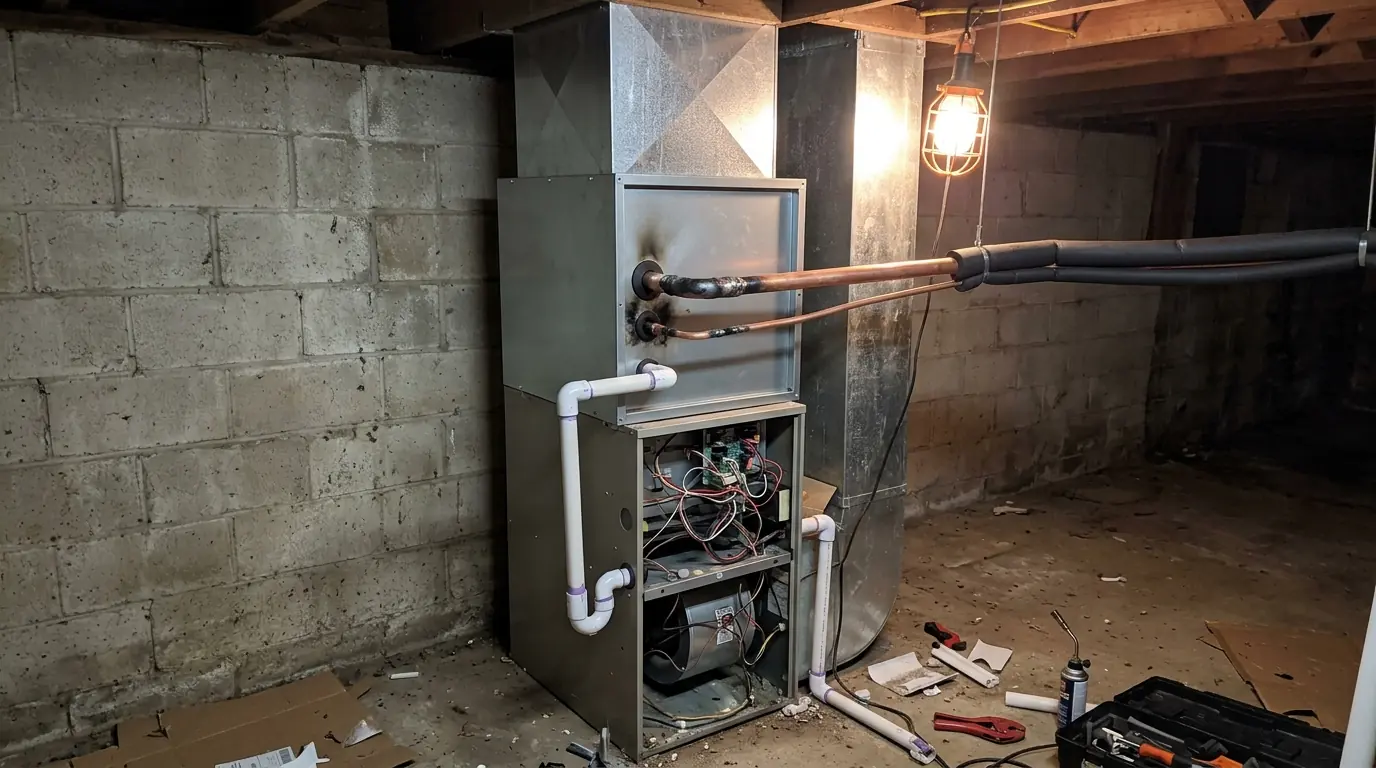
A basement furnace usually takes an upflow coil, while crawlspace and attic installs often need a horizontal coil with its drain pan on the correct side.
Rated pairing with the condenser
Manufacturers publish which coils pair with each outdoor unit. An unmatched pair can lower efficiency and affect maker parts coverage on the condenser.
Drain connections and safety
Primary and secondary drain ports must line up with the existing condensate line and float switch, or those connections get rebuilt.
How an evaporator coil swap is done right
A coil replacement usually takes five to seven hours. The vacuum and charge at the end decide how long the repair lasts.
Recover the refrigerant
We recover the remaining charge into a recovery cylinder. If the condenser is healthy, we may pump the charge down into it instead.
Remove the old coil
We cut the lines, disconnect the drain, and lift out the old coil. The plenum and furnace top are checked for rust and air leaks.
Set and braze the new coil
The new coil goes in level so it drains properly. Joints are brazed with nitrogen flowing to keep scale from forming inside the tubing.
Replace the filter drier
A new filter drier goes into the liquid line to catch moisture and debris. Then the system is pressure tested with dry nitrogen.
Vacuum, charge and verify
We pull a vacuum below 500 microns, confirm it holds, weigh in the charge, then fine tune by subcooling and record the temperature split.
Evaporator coil replacement cost in 2026
Most coil replacements on R-410A systems land in this range, including the coil, filter drier, labor, refrigerant and startup checks.
- Coil size and type. A 2-ton cased upflow coil costs less than a 4-ton horizontal coil or one built for a variable-speed system.
- Refrigerant amount. Recovering and recharging adds cost by the pound. Systems with long line sets or a fully lost charge need more.
- Install location. Basement coils are the quickest. Attic and crawlspace coils take longer to reach and often need new drain pans or supports.
- Plenum and transition work. If the new coil is a different width or height, the supply plenum or a transition piece may need to be rebuilt and sealed.
- Maker parts coverage. If the original equipment is still covered, the coil itself may be covered, and the bill becomes labor, refrigerant and supplies.
The written price comes after we look at the system and confirm the coil is the leak source. If a full system makes more sense, you'll see both prices. Compare typical prices for every service.
Coil replacement in Lexington basements, crawlspaces and attics
Where the coil sits changes the work. Basement furnaces in 1990s and 2000s homes around Hamburg and Andover usually give clear access from above, so the swap is straightforward. Crawlspace systems in older ranches often sit on blocks with limited headroom, and the coil may need to come out sideways. We check the drain slope and the secondary pan on those every time.
Attic systems, more common in some newer two-story homes, add summer heat to the job and a ceiling below the coil. A rusted pan in an attic is a ceiling stain waiting to happen. When we replace an attic coil, we inspect the pan, the float switch and the condensate drain line before closing up.
If the outdoor unit is old enough that a coil swap feels like money poured into a fading system, call (859) 377-8167 and ask us to price a full system replacement alongside the coil. Seeing both numbers on one visit, with the age and condition of each part written down, makes the decision much easier.
We work on Carrier, Trane, Lennox, Rheem and Goodman equipment along with every other major brand found in Lexington homes, and the same testing comes first on all of them.
Where we handle evaporator coil replacement most often
We cover every Lexington neighborhood and the towns around it. These are the places we visit most for this work; the full list is on our Fayette County page and the service area page.
Evaporator Coil Replacement: what Lexington homeowners ask
How do I know the evaporator coil is the source of my AC leak?
We confirm it before pricing. An electronic detector picks up refrigerant near the coil, and bubble solution or a nitrogen pressure test isolates the leak. If the outdoor unit and line set hold pressure while the coil section drops, the coil is the source. Oily residue on the coil face or tube bends is another sign we look for.
Can an evaporator coil leak be repaired instead of replaced?
Sometimes, if the leak is at an accessible return bend or a brazed joint on the outside of the coil. Most coil leaks are pinholes from formicary corrosion deep in the tube rows, where brazing isn't possible and more pinholes are usually forming. In those cases a patch fails again within a season or two, so replacement is the lasting fix.
Does a new evaporator coil have to be the same brand as my condenser?
Not always, but it must be rated to pair with that condenser. Manufacturers publish matched combinations, and some aftermarket coils are rated with major brands such as Carrier, Trane, Lennox and Goodman. A rated pairing keeps efficiency where it should be and avoids problems with maker parts coverage on the outdoor unit.
How long should a new evaporator coil last in a Lexington home?
A coil installed correctly often lasts 12 to 20 years. Humidity, household chemicals and drain maintenance all affect it. Coils in damp crawlspaces tend to corrode faster, while basement coils in conditioned space usually last longer. Keeping the filter changed and the drain clear helps the coil reach the upper end of that range.
Need evaporator coil replacement today?
A person answers (859) 377-8167 day and night. Tell us what you are seeing and a technician takes it from there.