Emergency & Projects · Lexington, KY
Light commercial HVAC for Lexington shops and offices
Your shop, office, clinic or church runs on rooftop units or split systems, one of them is struggling, and you need a plan that keeps the doors open and the space comfortable.
Lexington and nearby counties
Line open 24/7Short answer: Light Commercial HVAC in Lexington, KY
Light commercial HVAC covers the packaged rooftop units and split systems, usually 3 to 25 tons, that heat and cool small businesses. Good service means scheduled maintenance on every unit, fast repair when one fails, and replacement planned around your hours and roof. Most small business owners do best keeping a simple record of each unit's age, tonnage and repairs, so replace or repair decisions rest on facts.
Rooftop packaged units versus split systems for a small building
Most small commercial spaces in Lexington use one of these two layouts. Each has its own service and replacement needs.
| Detail | Packaged rooftop unit | Split system |
|---|---|---|
| Where it sits | All components in one cabinet on the roof | Condenser outside, furnace or air handler inside |
| Common sizes | 3 to 25 tons | 1.5 to 5 tons per system |
| Heat source | Gas heat section or electric strips | Gas furnace, heat pump or strips |
| Replacement access | Often needs a crane and a curb adapter | Usually ground level and indoor access |
| Typical tenants | Retail strips, offices, restaurants | Converted houses, small offices, churches |
Rooftop unit problems we fix most often
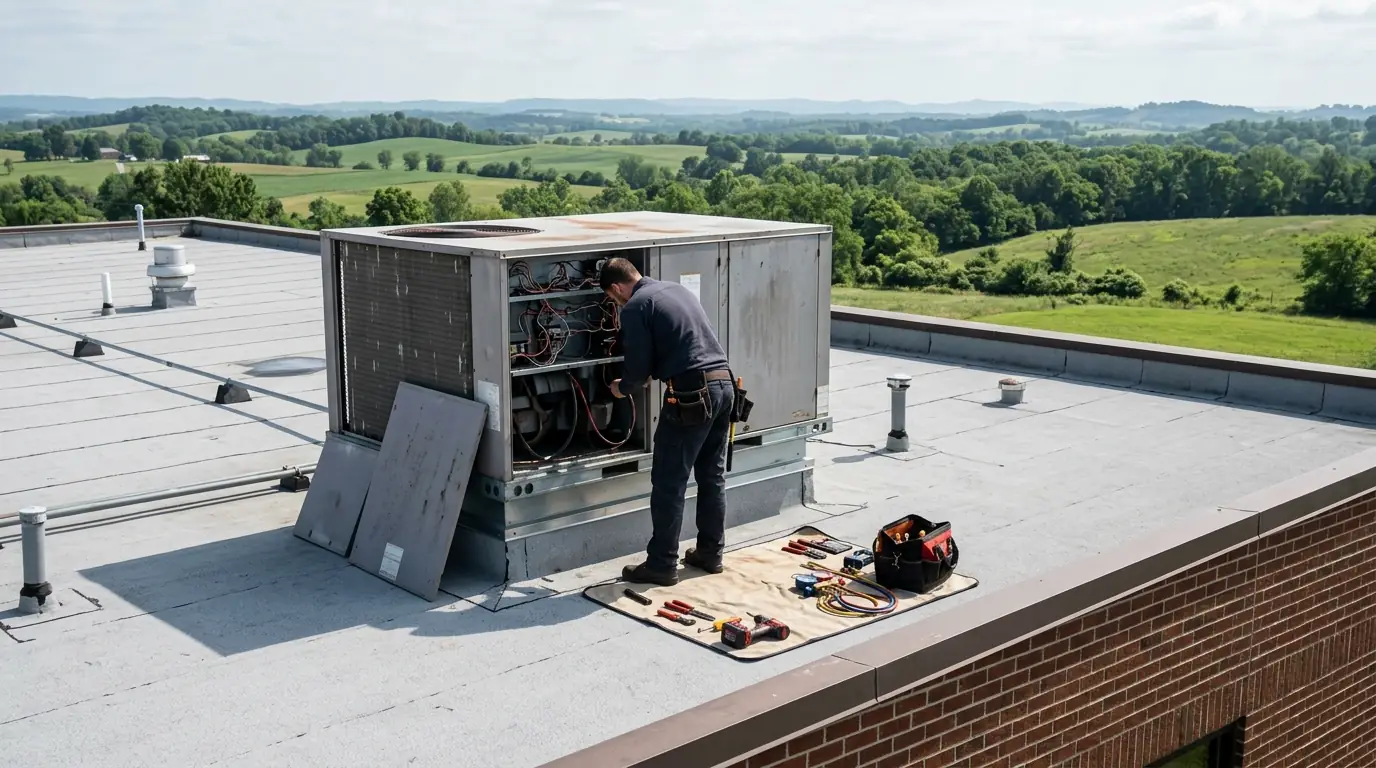
Rooftop units live in the weather and run long hours. These faults account for most of the calls we take from small businesses.
Failed contactor or capacitor
Summer heat and constant cycling wear out contactors and dual run capacitors. The fan runs but the compressor does not, and the space warms up by early afternoon.
Belt and blower wear
Many rooftop units drive the blower with a belt. A slipping or broken belt cuts airflow to the space while the unit keeps running and icing the coil.
Gas heat section lockouts
Rooftop gas heat uses the same igniters, flame sensors and pressure switches as a home furnace, plus inducer motors that rust from rain blowing into the vent hood.
Economizer stuck open
Economizers bring in outdoor air for free cooling. A seized damper or failed actuator can pour humid July air or freezing January air into the space.
Clogged condensate pans
Rooftop drain pans collect algae and debris. When they back up, water finds the roof deck and ceiling tiles inside your business.
Dirty condenser coils
Cottonwood fluff, pollen and kitchen grease clog condenser coils, push head pressure up and trip compressors on the hottest afternoons.
How we plan maintenance around business hours
Commercial maintenance works best on a set schedule, usually spring for cooling and fall for heating. This is how we set it up.
Walk the building and roof
We record each unit's location, tonnage, age, refrigerant type, filter size and belt size, and note roof access, ladders and any safety concerns.
Set a visit schedule
We agree on visit dates that suit your hours, such as early mornings for a restaurant or a weekday for an office closed on weekends.
Service each unit
Filters, belts, coils, drain pans, electrical parts, refrigerant pressures, gas heat combustion and economizer operation are checked and recorded on every unit.
Report by unit
You get a short report for each unit with what we did, readings that are drifting, and repairs ranked by urgency, so you can budget ahead.
Repair calls with history
When a unit fails between visits, our technician arrives knowing its age, parts and past repairs, which shortens the time your space sits uncomfortable.
Rooftop unit replacement prices for central Kentucky businesses
This range covers most packaged rooftop replacements we price for small commercial buildings, from a 3-ton unit on a one-story office to a 10-ton unit on a retail space.
- Tonnage. A 3-ton unit costs a fraction of a 10-ton unit, and larger units also need bigger electrical service and gas lines.
- Crane and access. Most rooftop swaps need a crane, so street access, parking lot space and building height all change the cost of a lift.
- Curb adapter. When a new unit does not match the old roof curb, a curb adapter is needed, which adds parts and labor along with roofing coordination.
- Gas heat or heat pump. Gas heat models, electric heat models and packaged heat pumps each carry different equipment prices and connection work.
- Economizer and controls. Adding or replacing an economizer, or tying units to a programmable control, adds to the price but often lowers running costs.
These are typical installed ranges for 2026. Your written price comes after we look at the system, the roof and the electrical service. Compare typical prices for every service.
Small commercial buildings across Lexington and the Bluegrass
The small commercial spaces we work on run from converted houses near downtown, now law offices and salons, to retail strips along the main corridors and newer offices and clinics on the edges of town. Older converted houses often still have residential split systems, sometimes several, each serving a floor. Strip centers and newer buildings mostly use packaged rooftop units, often one per tenant space, with gas heat from Columbia Gas or electric heat on KU service.
Central Kentucky summers are hard on rooftop units. Roof surfaces in July run far hotter than the air, condenser coils clog with spring pollen and cottonwood, and humid nights test whether a unit removes enough moisture to keep the space from feeling sticky. Restaurants and gyms face the toughest loads. In winter, rooftop gas heat sections see snow and blown rain in their vent hoods, which is when inducers and igniters fail.
If your building's ductwork is old or leaking above a drop ceiling, sealing it can help a struggling unit keep up, and our commercial duct sealing covers that work. Leaky return plenums above ceiling tiles also pull in hot attic air, which shows up as a space that never cools on summer afternoons. When a unit fails on a busy day, our round-the-clock repair service answers the phone at any hour.
What a small business owner should track for each unit
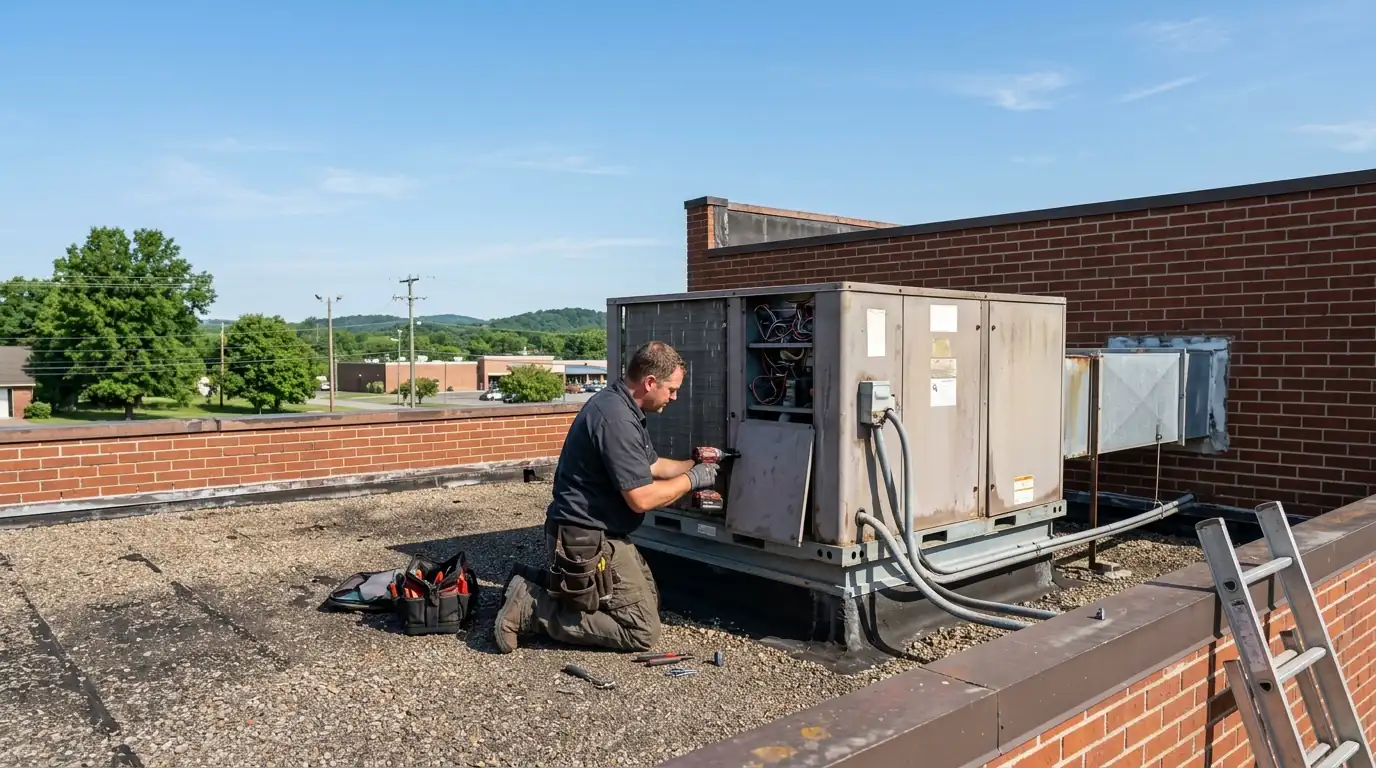
A one-page record per unit makes every repair and replacement decision easier. Call (859) 377-8167 and we can help you build it.
- Unit location, model and serial number from the data plate.
- Install year and tonnage, plus refrigerant type such as R-22 or R-410A.
- Filter size and count, and the date they were last changed.
- Belt size and the date of the last belt change.
- Every repair with date, part replaced and cost.
- Which tenant space or rooms each unit serves.
- Roof access details: ladder, hatch or key holder.
We work on Carrier, Trane, Lennox, Rheem and Goodman equipment along with every other major brand found in Lexington homes, and the same testing comes first on all of them.
Neighborhoods and towns that call us for light commercial HVAC
We cover every Lexington neighborhood and the towns around it. These are the places we visit most for this work; the full list is on our Fayette County page and the service area page.
Questions about light commercial HVAC in Lexington
How often should rooftop units on a small Lexington business be serviced?
Twice a year is the norm: a spring visit for cooling and a fall visit for heating. Restaurants, gyms and buildings with heavy pollen or cottonwood near the roof often benefit from quarterly filter and coil checks. Each visit includes filters, belts, coils, drain pans, electrical parts, refrigerant pressures, gas heat combustion and economizer operation.
Is it worth repairing an R-22 rooftop unit on a commercial building?
Small repairs like contactors, capacitors, belts and motors can still make sense on an R-22 unit. A refrigerant leak or failed compressor usually does not, because recovered R-22 is scarce and expensive. If your rooftop unit is R-22 and past 15 years, it is wise to plan and budget for replacement before it fails during a busy season.
Can a rooftop HVAC unit be replaced without closing my business?
Usually, yes. Most rooftop swaps finish in a single day, and we can often schedule the crane lift early in the morning or on a day you are closed. The space may be without heating or cooling for several hours. We plan the timing with you in advance and confirm the electrical and gas connections before the crane arrives.
Do you service light commercial heat pumps and split systems too?
Yes. Many small offices, churches and converted houses run residential-style split systems or commercial heat pumps rather than rooftop units. We service and repair those as well, following the same unit-by-unit records. Our heat pump repair page covers the faults we see on those systems.
Why does a rooftop unit leak water into the ceiling of my shop?
Most ceiling leaks under a rooftop unit come from a clogged condensate pan or drain, not the roof itself. Algae and debris block the drain, the pan overflows, and water runs along the curb into the building. A cracked pan, a missing drain trap or a coil that ices and then melts can do the same. We clear the drain, fit a proper trap and check the curb seal.
Call and describe what the system is doing
A person answers (859) 377-8167 day and night. Tell us what you are seeing and a technician takes it from there.