Emergency & Projects · Lexington, KY
Manufactured home heating and cooling around Lexington
Your manufactured home's furnace, heat pump or AC is old, noisy or losing ground, and you need equipment and duct work that actually fit how these homes are built.
Lexington and nearby counties
Line open 24/7Short answer: Manufactured Home HVAC in Lexington, KY
Manufactured homes need HVAC equipment rated for them: downflow furnaces and air handlers approved for manufactured housing, sealed combustion on gas or propane units, and condensers matched to a duct system that runs through the floor belly. The biggest decision is usually heat pump versus electric furnace or propane, followed by repairing the belly ducts and crossover. Most full replacements here run about $5,380 to $11,640.
How manufactured home HVAC differs from a site-built house
The equipment looks similar, but the rules and layout are different. These differences shape every repair and replacement we do in manufactured homes.
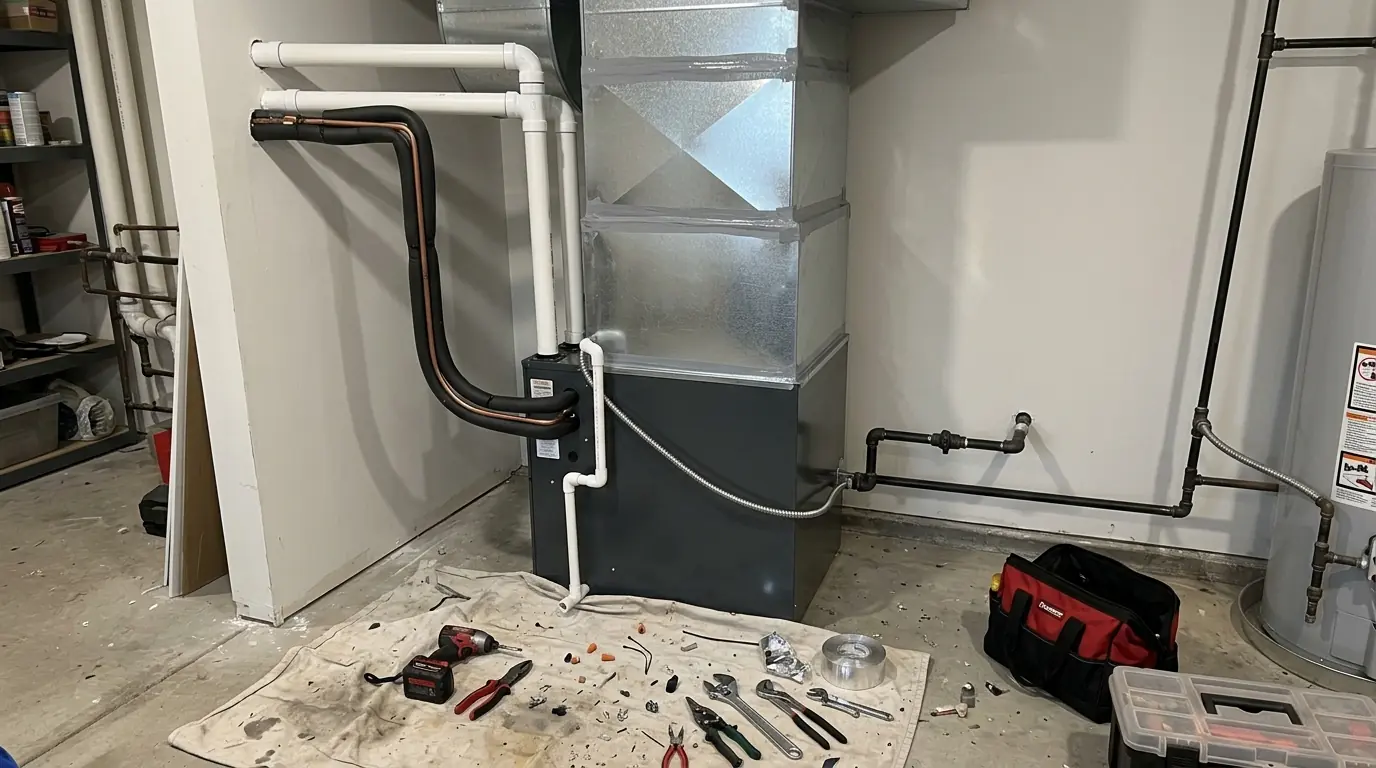
Manufactured-housing rated furnaces
Furnaces installed in manufactured homes must be listed for that use. They are usually compact downflow units with sealed combustion that pull air from outside rather than from the living space.
Floor belly duct trunk
Supply air runs through a single trunk line inside the insulated belly under the floor. Registers sit in the floor, and the trunk is often thin metal or ductboard.
Crossover duct on double-wides
Double-wide and larger homes join two duct trunks with a flexible crossover under the home. It sags, tears and lies on the ground more often than any other duct.
Closet return through the door
Many homes return air through a louvered furnace closet door rather than a ducted return. Blocking that door or storing items in front of it starves the blower.
Roof jack venting
Gas and propane furnaces vent through a roof jack built for the furnace model. Mismatched or damaged jacks cause draft problems and leaks.
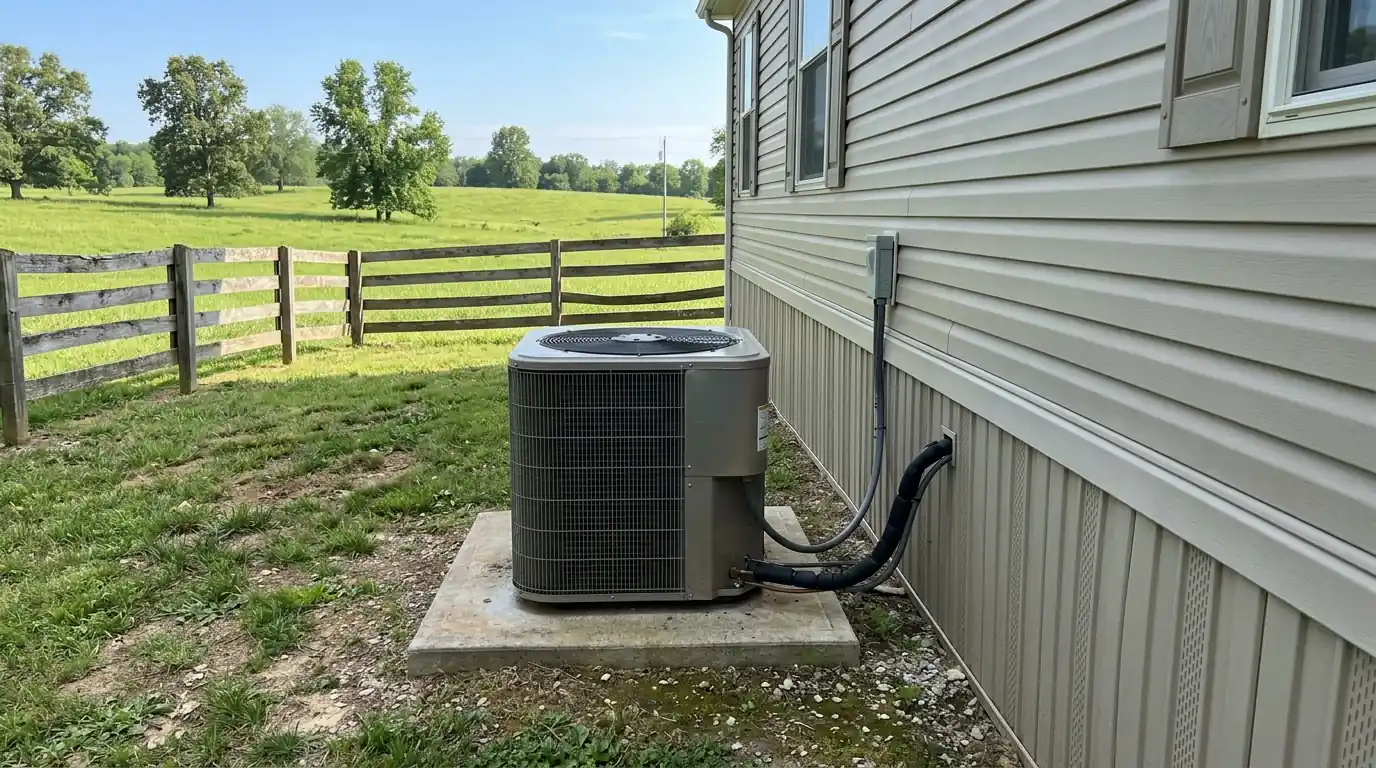
Outdoor unit on a pad near skirting
Condensers and heat pumps sit on a pad beside the home. Skirting, steps and shrubs often crowd them and cut the airflow they need.
Heat pump, electric furnace or propane for a manufactured home
Most manufactured homes around Lexington heat with one of these three. Fuel availability and your KU bill often decide it.
| Option | Running cost in winter | Good fit when |
|---|---|---|
| Heat pump with strip backup | Lowest of the three in most winters | You already have central air or want it |
| Electric furnace with AC | Highest, all heat from strips | Budget is tight and use is light |
| Propane furnace with AC | Varies with propane price | Propane is already on site |
| Natural gas furnace with AC | Usually low | A gas line serves the lot |
Manufactured homes on rural lots around the Bluegrass
Manufactured homes around Lexington are spread across communities on the city edges and on rural lots in the surrounding counties, from Jessamine County to Madison and Scott. Many of those lots sit beyond the reach of Columbia Gas lines, so heat comes from electric strips, a heat pump or propane. KU or a rural electric cooperative supplies power, and an older electric furnace running full strip heat can push winter bills uncomfortably high in a cold snap.
The ground under these homes matters as much as the equipment. Central Kentucky clay and limestone hold water after spring rain, and under-home spaces stay damp. Belly wrap tears, insulation falls, and animals nest in the gap and chew ducts. When we find a home that never cools well in July, the cause is often a crossover lying in mud or a trunk line split open, leaking conditioned air under the floor rather than into the rooms.
Humid summers add one more strain. A single-wide with thin walls and a low ceiling gains heat fast on a July afternoon, and an outdoor unit boxed in by skirting and steps recirculates its own hot exhaust air. Oversized replacements make it worse, cooling the air quickly but leaving the home damp. We size equipment to the home's real load, not the largest unit the closet will hold, so it runs long enough to pull moisture out.
What a manufactured home HVAC visit includes
Whether the call is a repair or a replacement estimate, we look at the whole path the air takes, not only the box in the closet.
Read the data plates
We note the home's data plate, the furnace or air handler model, its manufactured-housing listing and the outdoor unit size, so replacements match what the home requires.
Test the equipment
Furnace combustion or strip heat amps, heat pump refrigerant pressures, blower speed and temperature rise are measured just as on any site-built system.
Check under the home
With your permission, we go under the home to inspect the crossover, trunk joints and belly wrap, and we photograph torn or disconnected sections.
Explain the options
You get written choices covering the repair or replacement, any duct and crossover work, and the expected effect on comfort and winter bills.
Install and seal
Equipment is set on proper bases, the crossover is lifted off the ground and strapped, and duct joints are sealed with mastic before we test airflow.
Manufactured home system replacement costs near Lexington
This range covers most full system replacements we price for single-wide and double-wide homes, from an AC and electric furnace swap to a new heat pump with duct work.
- Equipment type. An electric furnace and AC pairing costs less up front than a heat pump system, though the heat pump usually costs less to run each winter.
- Home size. Double-wide and triple-wide homes need larger equipment, more tonnage outside and usually a longer crossover duct than a typical single-wide home.
- Duct and crossover repair. Replacing a torn crossover, sealing trunk joints or patching belly wrap is priced as its own line, and it often fixes comfort problems.
- Propane or gas connection. Gas and propane furnaces need a listed vent kit, roof jack and gas connection, which adds parts compared with electric heat.
- Electrical service. Older homes may need a new disconnect, breaker or larger wire for a heat pump with strip heat.
These are typical installed ranges for 2026. Your written price comes after we look at the system and the ducts under the home. Compare typical prices for every service.
Upkeep that keeps manufactured home systems running
A few simple habits prevent many of the calls we take from manufactured home owners. If anything looks wrong, call (859) 377-8167.
- Keep the furnace closet door clear and its louvers uncovered.
- Change the filter on schedule; many furnaces take a filter behind the front panel.
- Clear at least two feet around the outdoor unit and trim nearby shrubs.
- Look under the home each spring for sagging crossovers or torn belly wrap.
- Make sure skirting vents are open so moisture can escape.
- Keep floor registers open and free of rugs and furniture.
- Check the roof jack after storms for loose flashing or missing caps.
We work on Carrier, Trane, Lennox, Rheem and Goodman equipment along with every other major brand found in Lexington homes, and the same testing comes first on all of them.
Lexington-area places we cover for manufactured home HVAC
We cover every Lexington neighborhood and the towns around it. These are the places we visit most for this work; the full list is on our Fayette County page and the service area page.
Questions about manufactured home HVAC in Lexington
Can I put a regular furnace in my manufactured home?
No. Furnaces installed in manufactured homes must be listed for manufactured housing. These models use sealed combustion, so they draw air from outside rather than from the home, and they are built to fit the downflow closet and floor duct system. Putting a standard furnace in its place creates a safety and code problem, so every furnace we install in a manufactured home carries that listing.
Why is one end of my double-wide always colder than the other?
The most common cause is the crossover duct that carries air from one half to the other. If it is torn, crushed, disconnected or lying on cold ground, the far half gets weak, cool air. Leaks along the main trunk add to it. We inspect the crossover, replace it if needed and strap it up off the ground.
Is a heat pump a good choice for a manufactured home in Kentucky?
Usually it is. A heat pump uses far less electricity than strip heat for most of our winter and provides cooling in summer. Electric strips stay as backup for the coldest nights. Homes with propane already on site can also look at dual fuel. Our heat pump installation page explains sizing and options in more detail.
How long do manufactured home HVAC systems usually last?
Manufactured home furnaces and air handlers often last 15 to 20 years, and outdoor units 12 to 15. Damp under-home conditions, blocked closet returns and crowded outdoor units shorten that life. Electric furnaces often keep running longer, but heat strips and blower motors wear, and an electric furnace repair can often extend a sound unit.
Call and describe what the system is doing
A person answers (859) 377-8167 day and night. Tell us what you are seeing and a technician takes it from there.