Indoor Air Quality · Lexington, KY
Whole-house humidifiers in Lexington for dry winter air
By January the house reads 25 percent humidity, every doorknob gives you a shock, noses are dry in the morning and the hardwood floors have opened up. Running the heat all day pulls moisture out faster than the house can replace it.
Lexington and nearby counties
Line open 24/7Short answer: Whole-House Humidifiers in Lexington, KY
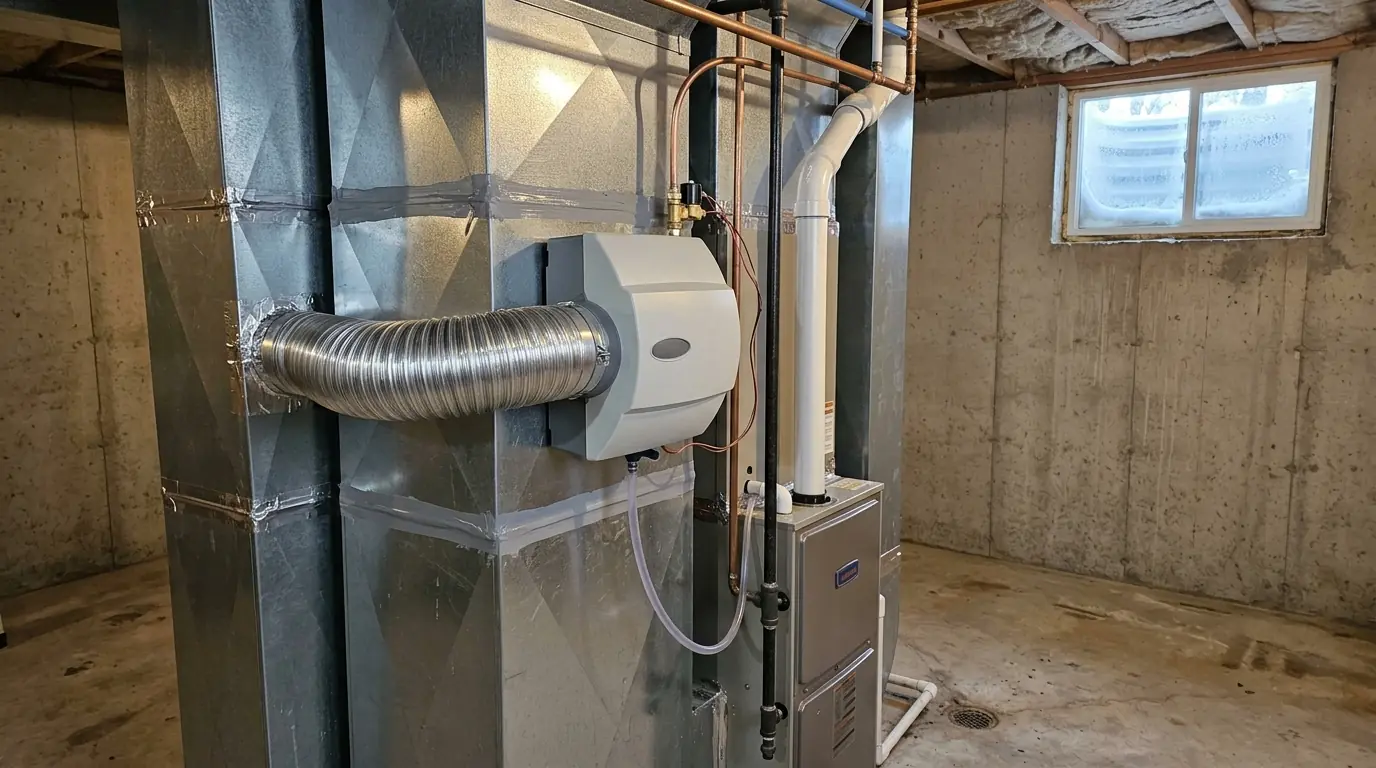
A whole-house humidifier mounts on your furnace or air handler and adds moisture to heated air before it reaches the rooms. Bypass and fan-powered models use a water panel and work best with gas furnaces. Steam models make their own vapor and suit heat pumps and tight homes. Aim for 30 to 40 percent in winter, lowered on cold nights to stop window condensation.
Bypass, fan-powered or steam: how the three compare
The best type depends mostly on your heating equipment, since some designs need hot supply air to work well.
| Type | Works best with | Points to weigh |
|---|---|---|
| Bypass with water panel | Gas furnaces with warm supply air | Simple and low cost, needs room for a bypass duct |
| Fan-powered with water panel | Gas furnaces where a bypass won't fit | More output, needs a power connection |
| Steam canister or electrode | Heat pumps and large or tight homes | Most output and control, uses more electricity |
Why heat pump homes usually need a steam humidifier
Bypass and fan-powered humidifiers work by blowing warm air through a wet panel. The warmer the air, the more water it picks up. A gas furnace delivers supply air around 120 to 140 degrees, which evaporates plenty of water. A heat pump in heating mode often delivers 90 to 105 degree air, and on cold days when it's working hardest, that air simply can't carry enough moisture off a panel.
Steam humidifiers don't depend on air temperature. They boil water in a canister and inject the vapor into the duct, so output stays steady regardless of what the heat pump is doing. That makes them the right choice for most all-electric homes, homes with dual fuel heat pump systems that spend most hours on the heat pump, and larger houses where a panel unit can't keep up.
Steam units do use more electricity and need their canister changed periodically, especially with Lexington's hard limestone water, which leaves mineral scale. We size the unit so it runs only as much as needed, and set it to follow the outdoor temperature so it doesn't overshoot. Gas furnace homes with room for a bypass duct rarely need steam, and a panel unit is simpler to own.
What dry winter air is doing to your house
Low humidity affects people and the house itself. These are the complaints we hear most often from December through February.
Static shocks everywhere
Below about 30 percent humidity, static builds up as you walk across carpet. Shocks off light switches and car doors are one of the first signs the air is too dry.
Dry skin and sinuses
Cracked lips, itchy skin and a dry nose on waking all get worse as indoor humidity falls into the low 20s during long cold spells.
Gaps in wood floors
Hardwood floors shrink in dry air, leaving visible gaps between boards that close again in summer. Trim joints and stair treads can open up too.
Instruments and furniture
Pianos drift out of tune, guitar necks move and antique furniture joints loosen when humidity swings from 60 percent in summer to 20 in winter.
Feeling cold at 70 degrees
Dry air pulls moisture off your skin, which cools you. Many people raise the thermostat in winter when better humidity would keep them comfortable at a lower setting.
Dust that feels worse
Dry mucous membranes trap less dust and irritants, so allergy and asthma symptoms can flare in winter even when pollen counts are low.
Fitting a humidifier to your furnace or air handler
Most humidifier installs take half a day. Steam units with a dedicated circuit can take a little longer.
Check heat type and space
We look at your heating equipment, supply temperature and the room around the plenum to decide which humidifier type fits and where it mounts.
Mount and connect ducts
The unit mounts on the supply or return plenum. Bypass models get a short duct between supply and return, sealed with mastic and fitted with a seasonal damper.
Run water and drain
A saddle or tee valve on a cold water line feeds the unit, and a drain line goes to a floor drain or condensate pump.
Wire the controls
We connect power and the humidity control, and add an outdoor temperature sensor so the target drops automatically on very cold nights.
Test and set targets
With heat running, we confirm the unit adds moisture, check for leaks at fittings and set a winter target with you.
Installed humidifier prices across central Kentucky
A bypass humidifier on a basement gas furnace falls near the low end. Steam units for heat pumps or large homes land toward the top.
- Humidifier type. Bypass models cost the least. Fan-powered units add a motor and a power connection, and steam units cost the most in equipment and wiring.
- Water and drain access. A furnace near a water line and floor drain is straightforward. Long water runs, or a condensate pump to move drain water, add labor.
- Electrical needs. Larger steam humidifiers often need a dedicated 240 volt circuit. Running one to the furnace location is part of the cost when there isn't one.
- Plenum space. Tight closets and attic air handlers sometimes need a remote-mount steam unit or modified duct work to fit a humidifier properly.
- Yearly upkeep. Water panels need replacing each season, and steam canisters every one to three seasons depending on water hardness and runtime.
The written price comes after we look at the system, the water supply and the drain, so the type we suggest fits your heating equipment. Compare typical prices for every service.
Cold snaps, hard water and window condensation in Lexington
Most central Kentucky winters bring weeks of nights in the 20s and occasional cold snaps into single digits. Outdoor air at 20 degrees carries very little moisture, and every bit that leaks inside gets heated and dried further. Older homes near downtown and in houses in Chevy Chase with original windows leak more air, so they often drop below 25 percent indoors without help.
The limit is the windows. When it's 10 degrees outside, the inside face of a double-pane window can be cold enough to fog or frost at 40 percent humidity. That's why we install an outdoor sensor. It lowers the target automatically on cold nights, often to 30 or 35 percent, so you get comfort without water running down the sills and staining the wood.
Lexington's water is hard because it comes off limestone, and minerals build up in humidifiers. Water panels clog and steam canisters scale faster here than in soft-water regions. Changing the panel each fall during a fall furnace tune-up keeps output up. To talk through which humidifier suits your system, call (859) 377-8167.
We work on Carrier, Trane, Lennox, Rheem and Goodman equipment along with every other major brand found in Lexington homes, and the same testing comes first on all of them.
Where we handle whole-house humidifiers most often
We cover every Lexington neighborhood and the towns around it. These are the places we visit most for this work; the full list is on our Fayette County page and the service area page.
Whole-House Humidifiers: what Lexington homeowners ask
What humidity should a whole-house humidifier keep in a Kentucky winter?
Between 30 and 40 percent works for most homes. On the coldest nights, drop toward 30 percent to keep condensation off windows, especially older single or double-pane glass. An automatic control with an outdoor sensor does this adjustment for you, which is much easier than changing the setting by hand every cold front.
Can a whole-house humidifier cause mold in the ductwork?
When it's sized and set correctly, no. Problems come from humidifiers set too high, units that keep running when the blower is off, and bypass dampers left open into summer. We wire the unit so it only runs with the blower and heat, and we set a sensible target. A water panel left dirty for years can also grow slime, so change it yearly.
Do I need to shut off the humidifier in summer?
Yes. Close the water supply valve and, on bypass models, close the summer damper so cooled air doesn't flow through the bypass duct. Turn the humidity control to off. In fall, replace the water panel, reopen the damper and water valve, and set the winter target. This takes about ten minutes.
Will a whole-house humidifier lower my heating bill?
It can help a little. Air at 35 percent humidity feels warmer than air at 20 percent at the same temperature, so many people find they're comfortable a degree or two lower on the thermostat. The savings vary by house and habit, so think of comfort and protecting floors and furniture as the main reasons.
Ready to talk about whole-house humidifiers?
A person answers (859) 377-8167 day and night. Tell us what you are seeing and a technician takes it from there.