Heating · Lexington, KY
Garage and shop heaters for Lexington homes and farms
Your garage is too cold to work in from November to March, the old shop heater smells or quits, or you're putting up a detached shop or barn workshop and want heat that is safe around tools and vehicles.
Lexington and nearby counties
Line open 24/7Short answer: Garage & Shop Heaters in Lexington, KY
Most garages and shops around Lexington are heated one of four ways: a vented gas or propane unit heater hung from the ceiling, an infrared tube heater for tall bays with big doors, a ductless mini split that heats and cools, or a 240-volt electric unit heater for small spaces. The right pick depends on insulation, ceiling height, the fuel you have and how often you use the space.
Unit heater, infrared tube, mini split or electric for your garage
Each option suits a different kind of building. This is how we compare them before we walk through yours.
| Heater type | Runs on | Works best for |
|---|---|---|
| Vented gas unit heater | Natural gas or propane | Insulated garages and shops that need fast heat |
| Infrared tube heater | Natural gas or propane | Tall bays, big doors and drafty barn shops |
| Ductless mini split | Electricity | Daily-use spaces that need heat and cooling |
| Electric unit heater | 240-volt electricity | Small insulated garages used now and then |
Sizing heat for a detached shop or barn workshop
Heater size starts with three things: how much air is inside, how well the walls, ceiling and doors hold heat, and how warm you want the space on a cold morning. An insulated two-car garage with a 9-foot ceiling usually needs about 30,000 to 45,000 BTU from a gas unit heater. A 12,000 to 18,000 BTU cold-climate mini split can do the job if you hold the space near 55 degrees and warm it up when you work.
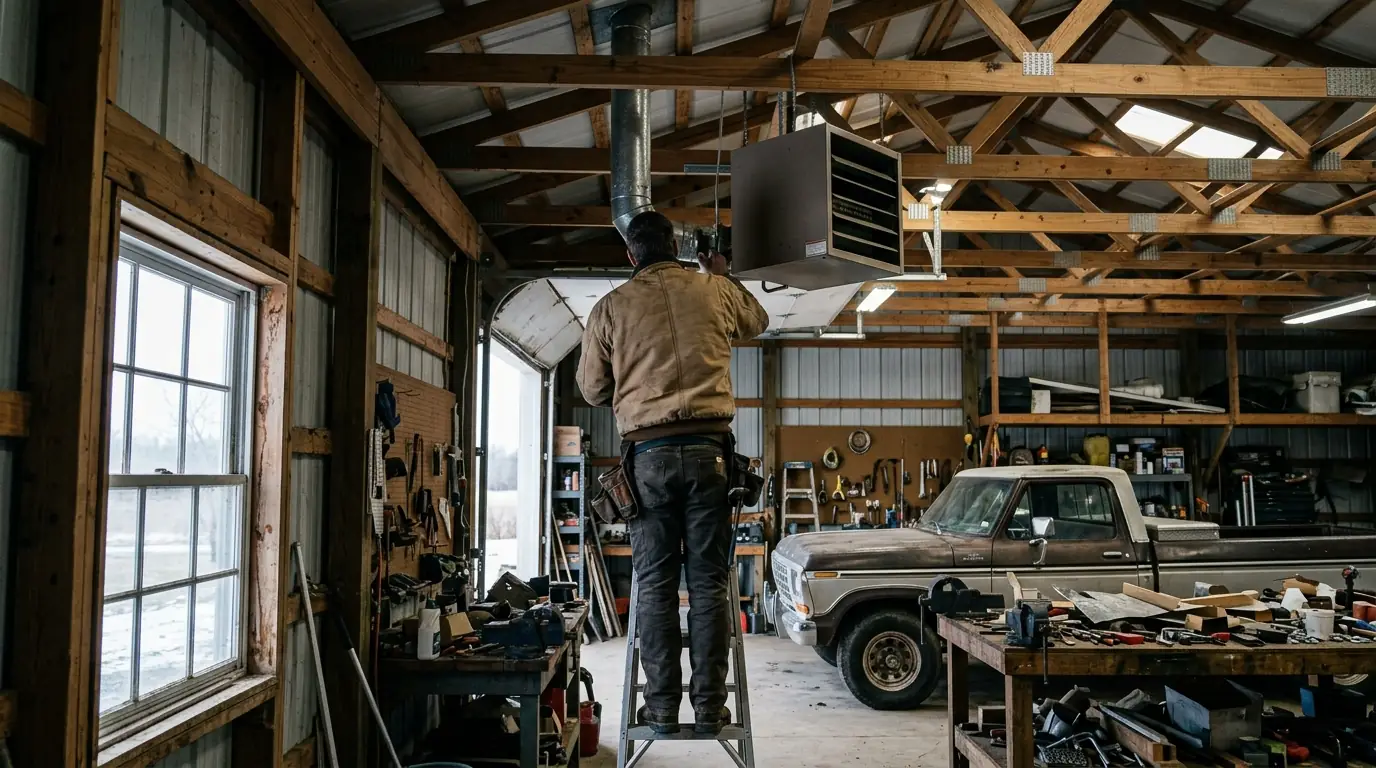
Detached shops and pole barns change the math. A metal building with bare girts and a 12-foot roll-up door can lose heat several times faster than an insulated garage, and a 40 by 60 barn workshop can need 125,000 BTU or more to stay workable. In buildings like that, we often suggest insulating the ceiling and the big door first. A smaller heater in a tighter building costs less to buy and run than a large one fighting the wind all winter.
Clearances, fumes and carbon monoxide in a heated garage
A garage holds gasoline, solvents, sawdust and running engines, so heater safety comes down to a handful of basics.
Listed clearances to combustibles
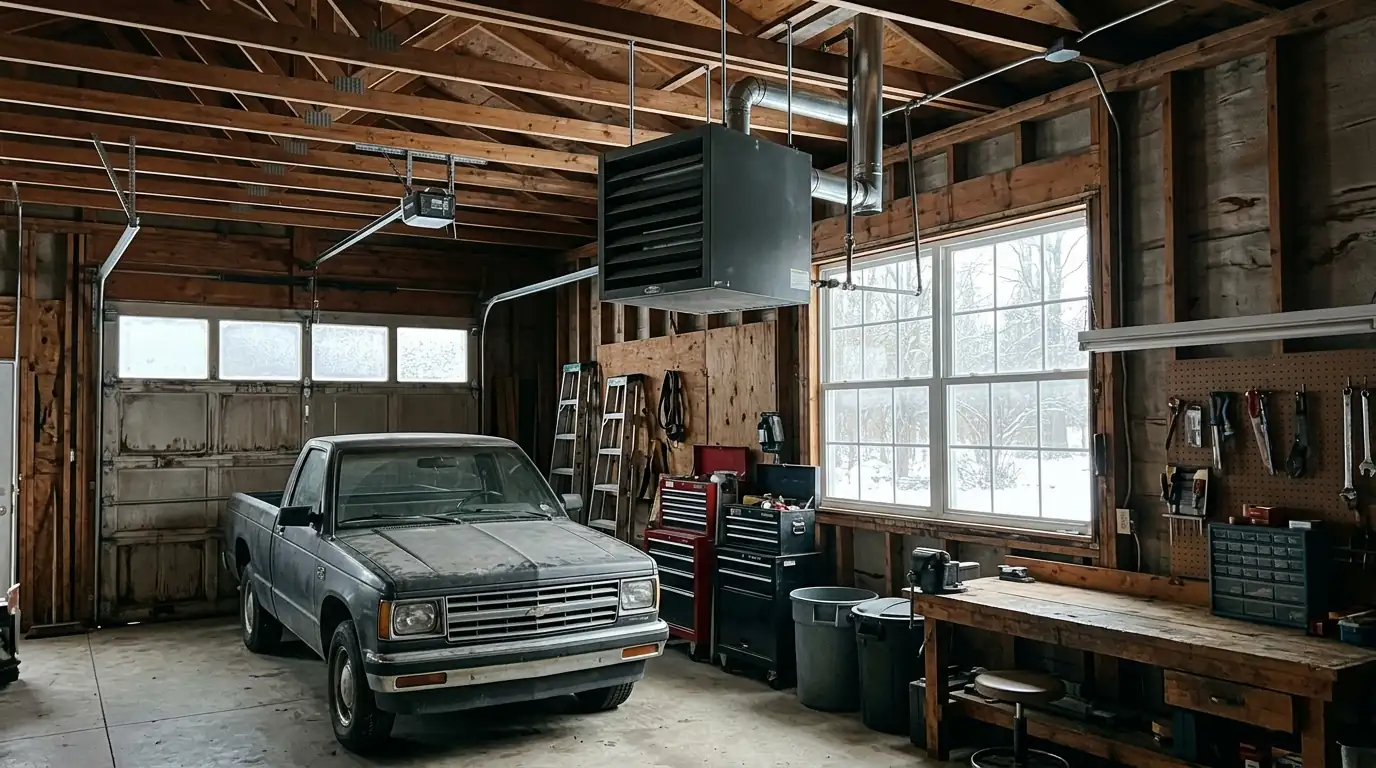
Every heater comes with distances it must keep from walls, ceilings, shelving and stored items. We mount it so lumber racks, boxes and the opened garage door never crowd that space.
Fuel vapors settle low
Gasoline and solvent vapors are heavier than air and pool near the floor. Gas heaters hang high, and fuel cans belong in a closed cabinet well away from any heater.
Vented heaters only
Gas and propane heaters in a closed garage need to send their exhaust outdoors through a wall or roof. Portable unvented torpedo heaters fill a shut garage with carbon monoxide and moisture.
A working carbon monoxide alarm
Any garage with a fuel-burning heater or a running car should have a carbon monoxide alarm nearby, and an attached garage calls for one inside the house by the connecting door.
Sealed combustion for dusty shops
Separated combustion heaters pull burner air from outdoors through their own pipe, so sawdust, sanding dust and finishing fumes stay away from the flame.
Shutoffs within reach
A gas shutoff valve and an electrical disconnect near the heater let you or a technician turn it off quickly without hunting through the basement.
Shop habits that change which heater we suggest
Two buildings of the same size can need different heaters. Tell us how you use the space when you call (859) 377-8167.
Woodworking and sanding
Fine dust coats burners and fan blades. A separated combustion gas heater or a mini split with a washable filter holds up far better than an open-flame unit.
Spray finishing or painting
Solvent fumes and open flames are a bad pair. We plan these shops around sealed combustion or electric heat and keep heaters well clear of the finishing area.
Vehicle lifts and tall doors
A raised truck or tractor needs room under the heater. Infrared tubes and unit heaters are placed so lifted vehicles stay well away from hot surfaces.
Heat a few times a month
If the garage sits cold most of the week, a gas unit heater that warms the space quickly usually costs less to run than holding heat around the clock.
Daily use, summer included
A shop used year-round gains the most from a mini split, which also dries the air in July and slows rust on hand tools and cast iron tables.
Welding and grinding
Sparks and hot slag call for heaters mounted out of the spark path, and infrared heat warms you without blowing fumes around the bay.
From measuring the bay to the first warm morning
Most single-heater garage installs take one day once the plan is set. Detached shops with long fuel runs can take two.
Walk the building
We measure the space, note insulation, doors and ceiling height, see what is stored where, and ask how warm you want it and how often you use it.
Size and place the heater
Heat loss sets the size. Placement keeps the listed clearances, aims the airflow across the bay, and stays out of the garage door track and any lift path.
Plan fuel and venting
We route the gas or propane line from your existing piping and choose a vent path through the wall or roof that ends away from doors and windows.
Hang, pipe and wire
The heater goes up on a hanger or bracket made for its weight, the fuel line gets a shutoff and sediment trap, and the thermostat goes where it reads the room.
Start up and test
We check gas pressure, burner flame and venting, measure carbon monoxide in the space, and run the heater through full cycles before we pack up.
What a garage or shop heater costs to install
This range covers one heater installed and running. Large shops with several heaters or very long fuel runs fall above it.
- Heater type and size. A small 240-volt electric heater sits at the low end, while infrared tubes and mini splits for large shops push toward the top.
- Gas or propane line length. A short run off a nearby furnace line costs far less than a long run to a detached shop, especially one that has to go underground.
- Venting route. A sidewall vent through a framed garage wall is simpler than a tall vent through a metal barn roof.
- Electrical supply. Electric heaters and mini splits need a circuit sized for them. A full panel or a long run to a detached building adds cost.
- Ceiling height and framing. High ceilings, steel trusses and pole barn framing take more time, brackets and lift equipment to hang a heater safely.
These are typical 2026 ranges for central Kentucky. Your written price comes after we see the building, the fuel supply and where the heater will hang. Compare typical prices for every service.
Pole barns, propane tanks and attached garages around Lexington
Garages in Lexington tend to fall into two groups. Many homes in 1990s and 2000s subdivisions have attached two- and three-car garages, often with a bonus room above, and Columbia Gas piping already in the basement makes a vented gas unit heater a short project. Heating the garage also takes the chill off that room overhead, but the heater must vent fully outdoors so exhaust never finds its way into the living space.
On farms in Fayette, Scott, Woodford and Bourbon counties, the shop is usually a pole barn or a detached block building with no natural gas nearby. Those properties run on propane, and most unit heaters and infrared tubes come in propane versions or convert with a kit. Our Scott County service page covers more of that rural work. Limestone close to the surface can make burying a fuel line slow, so we plan the route before anyone digs.
Central Kentucky weather pushes both ways. Single-digit cold snaps freeze paint, glue and water lines in an unheated shop, while muggy summers rust bare steel. That is why many owners who work out there year-round choose a cold-climate mini split, and why running a new gas line to an attached garage is often the quickest path to winter heat.
We work on Carrier, Trane, Lennox, Rheem and Goodman equipment along with every other major brand found in Lexington homes, and the same testing comes first on all of them.
Lexington-area places we cover for garage & shop heaters
We cover every Lexington neighborhood and the towns around it. These are the places we visit most for this work; the full list is on our Fayette County page and the service area page.
Garage & Shop Heaters: what Lexington homeowners ask
What size heater does a two-car garage in Lexington need?
An insulated two-car garage of about 500 to 600 square feet usually lands near 30,000 to 45,000 BTU for a gas unit heater, or 12,000 to 18,000 BTU for a cold-climate mini split. An uninsulated garage or one with a drafty door can need half again as much. We size from your actual walls, door and ceiling height rather than square feet alone.
Is it safe to run a propane torpedo heater in a closed garage?
No. Torpedo heaters and other unvented portable units send all their exhaust, including carbon monoxide and a lot of water vapor, straight into the room. They are built for open, ventilated work areas. In a closed garage, and especially one attached to the house, use a vented heater. If someone has been running a torpedo heater in an attached garage, a carbon monoxide safety check of the house is a sensible next step.
Can a ductless mini split keep a garage warm in a Kentucky cold snap?
A cold-climate mini split keeps much of its heating output into the single digits, so it can hold an insulated garage at a working temperature through most Lexington cold snaps. It struggles in drafty, uninsulated buildings or when the big door opens often. Mitsubishi Electric, Fujitsu and Daikin all make cold-climate lines we install and service.
Should a woodshop use a sealed combustion garage heater?
In most cases, yes. A separated combustion heater pulls the air for its burner from outdoors through a sealed pipe, so fine sawdust and finishing fumes in the shop never pass through the flame. That keeps the burner cleaner, lowers the fire risk from dust, and stops the heat exchanger from clogging. A mini split is the other good choice for a dusty shop.
Can a gas shop heater run on propane at a rural property?
Most can. Many unit heaters and infrared tube heaters are sold in both natural gas and propane versions, and some convert with a kit that changes the burner orifices and the gas valve setting. Propane runs at a higher pressure than natural gas, so the conversion has to be done and tested carefully. We also size the line from the tank to match the heater.
Ready to talk about garage & shop heaters?
A person answers (859) 377-8167 day and night. Tell us what you are seeing and a technician takes it from there.