Heating · Lexington, KY
Boiler repair in Lexington for cold radiators and lockouts
Your radiators or baseboard are cold, the boiler is banging, dripping or flashing a fault, and you need to know what you can safely check and when to stop and call.
Lexington and nearby counties
Line open 24/7Short answer: Boiler Repair in Lexington, KY
If your boiler stops heating, check the thermostat, the boiler power switch and the pressure gauge first. A hot water system should read about 12 to 15 psi cold. If the pressure is near zero, the relief valve is discharging, or you smell gas, shut the boiler off and call. Common repair causes are failed circulator pumps, waterlogged expansion tanks, stuck zone valves, ignition faults and air trapped in the loop.
What to check while the radiators are cold
These checks are safe for any homeowner. Stop at the first sign of water spraying, gas odor or a pressure gauge in the red.
- Confirm the thermostat calls for heat and its batteries are good.
- Check the boiler power switch, often red-plated near the stairs, is on.
- Read the pressure gauge: about 12 to 15 psi cold on most hot water systems.
- Look for water at the relief valve pipe or on the floor under the boiler.
- Note any fault code or flashing light on the boiler display or control.
- On steam boilers, check that the sight glass shows water about halfway.
- Do not add water to a hot steam boiler with a low sight glass.
- If you smell gas, leave the house and call Columbia Gas or 911 from outside.
Where hot water and steam boilers usually break
Boilers are simple machines with a handful of moving parts. These are the faults behind most of the boiler calls we answer.
Circulator pump failure
The boiler fires and gets hot, but radiators stay cold because the pump is not moving water. Seized impellers, burned windings and failed capacitors on older wet-rotor pumps are common.
Waterlogged expansion tank
When the tank's air charge is gone, pressure spikes every time the boiler heats, and the relief valve drips or sprays at 30 psi. Tapping the tank and hearing a solid thud is a clue.
Stuck zone valve
One part of the house stays cold while others heat. The zone valve motor head has failed, or its end switch never tells the boiler to fire.
Air in the loop
Gurgling pipes and cold upper radiators often mean trapped air. A failed automatic air vent or a low fill pressure lets air collect at the high points.
Ignition or flame faults
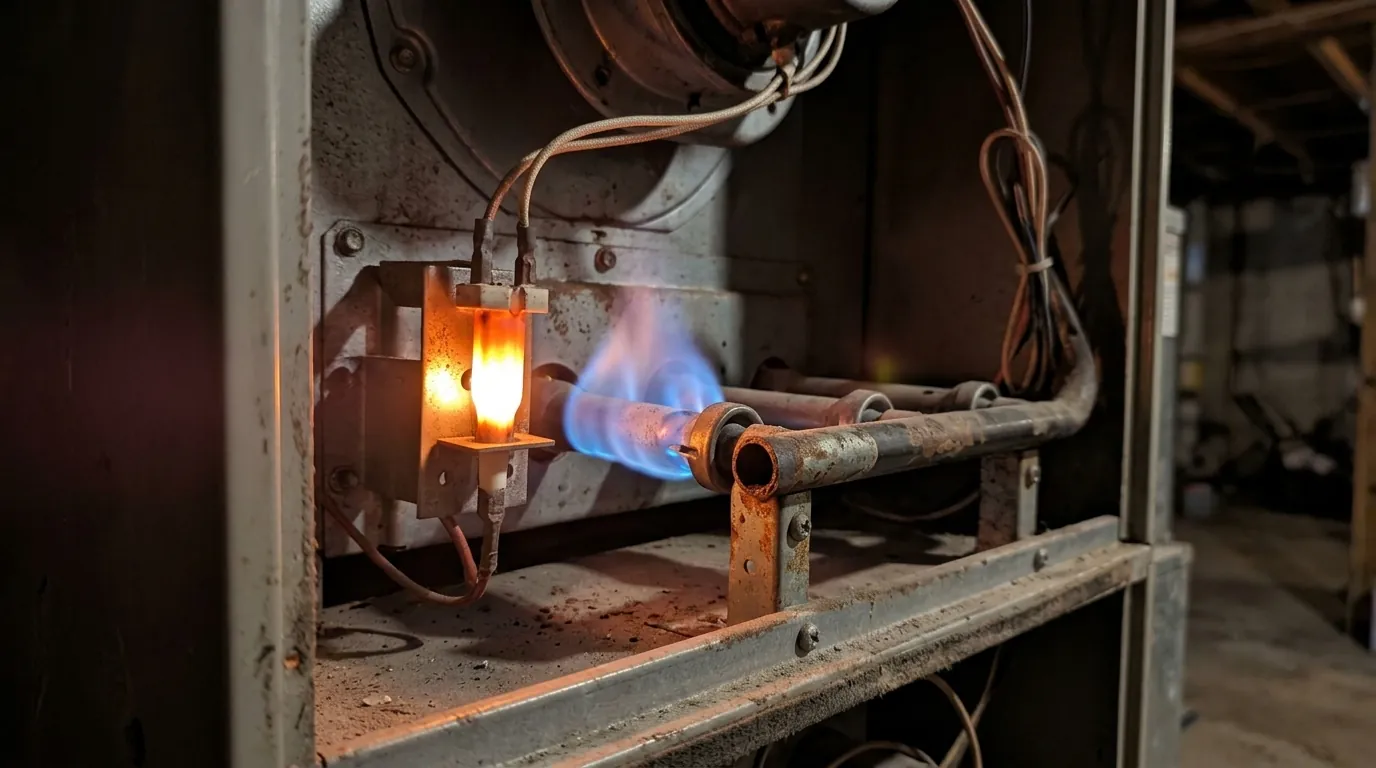
Modern boilers use the same flame rectification as furnaces, so dirty sensors and worn igniters cause lockouts. Older standing pilot boilers lose thermocouples.
Low water cutoff tripping
On steam boilers, sludge in the low water cutoff or a slow leak keeps the burner from firing. A dirty probe shuts the boiler down even with water in it.
How we track down a boiler problem
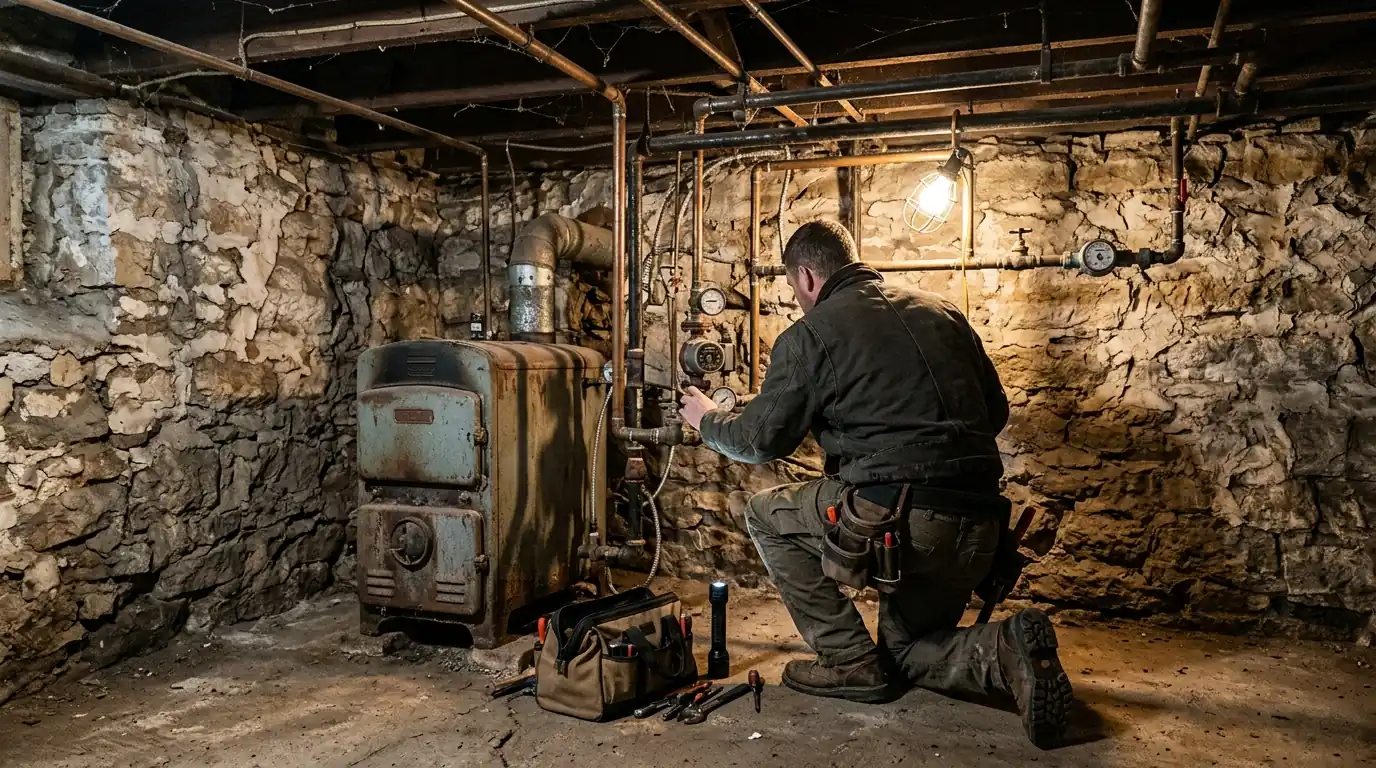
Boiler repairs depend on reading the system as a whole: water, pressure, flow and combustion. This is the order we work in.
Read pressure and temperature
We compare the boiler gauge with a test gauge, check supply and return temperatures, and note whether the relief valve has been discharging.
Prove each zone calls
Each thermostat is set to call for heat, and we confirm that its zone valve or circulator responds and that the boiler gets the signal to fire.
Test flow and air
We feel and measure temperature across each circulator, check the expansion tank charge with a tire gauge, and bleed air from the vents and radiators.
Check combustion
Flame signal, gas pressure, draft and carbon monoxide are measured at the flue, the same way we test a gas furnace.
Repair and verify
After we replace or repair the failed part, we bring the system to temperature, recheck pressure, and confirm every zone heats before we leave.
Radiators, cast iron and karst water in Lexington
Most of the boilers we work on in Lexington sit in older homes near downtown, in Chevy Chase, Ashland Park, Bell Court and Kenwick, where houses were built with cast iron radiators long before central air arrived. Many of those systems have been converted from coal or oil to Columbia Gas over the years, and some still run with gravity piping or oversized pipe that holds a lot of water. That adds time to filling and purging after a repair, and we plan for it.
Our hard, limestone water matters too. Lexington's karst ground gives the water plenty of calcium, and every time a leaking boiler takes on fresh water, a bit more mineral settles in the heat exchanger. That is why a slow leak is not harmless: the constant top-up builds scale, raises flue temperatures and can crack cast iron sections over time. Fixing leaks fast protects the boiler.
Many of these homes also added central cooling later. If you are considering air conditioning while keeping the boiler for heat, our central air for older homes guide explains how ductless and small-duct systems work beside a boiler. When a boiler is near the end of its life, we will say so honestly and price both paths.
Typical boiler repair prices around Lexington
Most residential boiler repairs fall inside this range. Small valves and sensors sit low, while circulators, controls and gas valves move toward the top.
- Part that failed. A relief valve or air vent costs far less than a gas valve, an outdoor reset control or a full circulator pump with flanges.
- Hot water or steam. Steam boilers have low water cutoffs, pressure controls and sight glasses that hot water systems lack, and parts are often harder to find.
- Draining and refilling. Some repairs mean draining the boiler or a zone, then refilling and purging air, which adds time on large cast iron systems.
- Brand and age. Parts for current cast iron and modern combi boilers are easy to get, while parts for discontinued models may need sourcing.
- Access and piping. Corroded unions, tight basements and old threaded piping can slow a simple swap and sometimes need new fittings.
These are typical repair ranges. Your written price comes after we look at the system, test it and explain which part failed. Compare typical prices for every service.
Boiler sounds and what they usually mean
Noise is often the first clue. If you can describe it on the phone at (859) 377-8167, we can bring the right parts.
Banging in steam pipes
Water hammer happens when condensate gets trapped in pipes that lost their pitch. Re-sloping pipes and checking the water level usually settle it.
Kettling or rumbling
A rumble inside the boiler, like a kettle about to boil, points to scale on the heat exchanger or poor flow through it.
Gurgling in baseboards
Moving air in a hot water loop gurgles. It usually means low pressure, a failed air vent or a system that was not purged after work.
Humming circulator, no flow
A circulator that hums but does not move water often has a seized impeller or a weak capacitor, and the boiler may trip its high limit.
We work on Carrier, Trane, Lennox, Rheem and Goodman equipment along with every other major brand found in Lexington homes, and the same testing comes first on all of them.
Where we handle boiler repair most often
We cover every Lexington neighborhood and the towns around it. These are the places we visit most for this work; the full list is on our Fayette County page and the service area page.
Further reading from our Comfort Blog
Central air for older Lexington homes without ducts
Plaster walls, radiators and tight attics make conventional ductwork hard to fit in Lexington houses from the 1910s to the 1940s. These are the cooling options that actually work in them.
Common questions on boiler repair around Lexington
Why is water dripping from my boiler relief valve?
The relief valve opens at about 30 psi to protect the boiler. A drip usually means the expansion tank has lost its air charge, the fill valve is letting in too much water, or the relief valve itself is worn. Never cap or plug the relief pipe. We test the tank charge and fill pressure, then fix the cause rather than only swapping the valve.
Why does only one zone of my boiler system stay cold?
When one zone is cold and the rest heat, the trouble is usually local to that zone: a failed zone valve motor, a stuck end switch, a dead zone circulator or air trapped in that loop. A bad thermostat or broken thermostat wire can do the same. We prove each zone's call, then check the valve and flow on the cold one.
Is it worth repairing an old cast iron boiler in Lexington?
Often, yes. Cast iron boilers can run 30 years or more with care, and most failures are in replaceable pumps, valves and controls. Repair stops making sense when sections crack and leak, when combustion cannot be brought into a safe range, or when repairs pile up. Our boiler replacement page covers what changes when you upgrade.
Can I bleed my own radiators when the boiler is gurgling?
On a hot water system, yes, with the boiler off and the water cooled a little. Use a radiator key, hold a rag under the vent, and close it when water runs steadily without air. Then check the pressure gauge, since bleeding lowers it. Steam radiators use automatic vents and should not be bled this way.
Need boiler repair today?
A person answers (859) 377-8167 day and night. Tell us what you are seeing and a technician takes it from there.