Indoor Air Quality · Lexington, KY
Fresh-air ventilation in Lexington for tight, stuffy homes
The house is tight and efficient, but bedrooms feel stuffy by morning, cooking smells linger for a day and the windows fog in winter. The air isn't being replaced often enough.
Lexington and nearby counties
Line open 24/7Short answer: Fresh-Air Ventilation in Lexington, KY
Fresh-air ventilation brings filtered outdoor air into the house and sends stale air out at a controlled rate. In central Kentucky's humid summers and cold winters, an energy recovery ventilator (ERV) is usually the better choice than an HRV, because it moves some moisture along with heat and keeps summer humidity from rising. Size it from the home's floor area and bedroom count, typically 50 to 120 cfm.
ERV or HRV in a humid Kentucky climate
Both units exchange stale indoor air for fresh outdoor air through a core that recovers energy. The difference is moisture, and that matters a lot here.
| Feature | ERV | HRV |
|---|---|---|
| Recovers heat | Yes | Yes |
| Transfers moisture | Yes, part of it | No |
| Summer humidity effect | Keeps much of it outside | Brings outdoor humidity in |
| Winter dryness effect | Retains some indoor moisture | Can make dry air drier |
| Best fit here | Most central Kentucky homes | Very tight homes with winter moisture |
Choosing a ventilation approach for your house
The first question is whether the house needs mechanical fresh air at all. Older ranches and two-stories built before the 1990s usually leak enough outdoor air on their own. Newer homes built tight, houses that have had spray foam, new windows and air sealing, and finished basements with little air exchange are the ones where CO2 climbs and smells linger. A short round of CO2 and humidity readings answers the question with numbers.
If ventilation is needed, an ERV is our usual recommendation in Lexington. Summer air here carries a lot of moisture, and an HRV brings that moisture straight in, where the air conditioner has to remove it. An ERV transfers part of it back to the exhaust stream. In winter, the ERV keeps some of the moisture you'd otherwise lose, which helps with dry air.
Simpler options exist. An exhaust-only fan running at low speed, or a fresh-air duct with a motorized damper tied into the furnace return, costs less up front. They work in some homes but bring in untreated air and depend on the main blower. We'll lay out the trade-offs for your house before you choose.
Signs a tight house is short on fresh air
These symptoms are common in newer and heavily upgraded homes. Two or three together usually mean the air exchange rate is too low.
Groggy mornings
Waking up stuffy or with a dull headache that clears after breakfast often lines up with bedroom CO2 readings above 1,500 ppm overnight.
Smells that hang around
Cooking odors that last into the next day, or a pet smell that never quite clears, mean air isn't being exchanged with the outside often enough.
Winter window condensation
Fog and water on window glass in winter, even with moderate humidity settings, often means moisture from showers and cooking has nowhere to go.
New-house smell that lingers
Paint, flooring and cabinet odors should fade within months. If they persist, VOCs are building up faster than ventilation removes them.
Backdraft at fireplaces
Smoke or odor pulled into the room when a kitchen hood or dryer runs means the house is under negative pressure and is short on makeup air.
Stuffy finished basement
Basement rooms with few windows and one supply register often feel stale, and they pick up musty smells when humidity rises in summer.
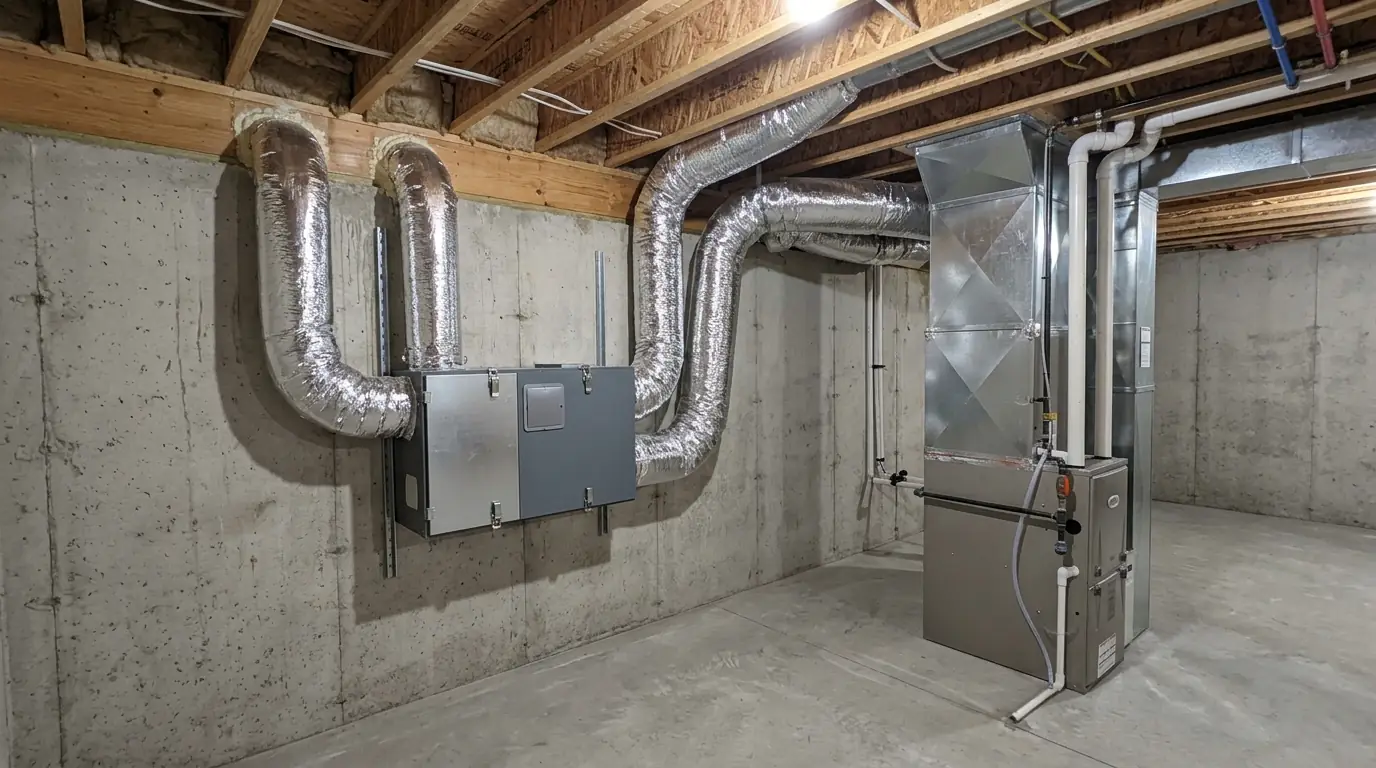
Installing an ERV with your existing ductwork
A typical ERV installation takes one to two days, depending on where the unit goes and how the fresh air and exhaust connect.
Size the airflow
We calculate the continuous ventilation rate from floor area and bedrooms, then confirm it against CO2 readings and how the house is used.
Pick the location
The ERV goes in a basement, utility room or conditioned attic space, close to the main air handler and within reach of an outside wall.
Cut in outdoor hoods
Fresh air intake and stale air exhaust hoods are placed at least ten feet apart, away from dryer vents, gas meters, garbage areas and driveways.
Connect and balance
Ducts connect the ERV to the return and to the outdoor hoods. We measure and balance intake against exhaust so the house isn't pressurized or depressurized.
Set the controls
We set run times, a boost switch for bathrooms or kitchens, and show you how to clean the filters and core.
ERV and fresh-air system pricing for 2026
A simple fresh-air damper tied into the furnace return falls at the low end. A fully ducted ERV with dedicated runs lands at the high end.
- System type. A motorized fresh-air damper costs far less than an ERV, and a fully ducted ERV with its own supply and exhaust runs costs the most.
- Unit capacity. Larger homes and homes with many bedrooms need higher-airflow units, which cost more and need bigger ducts and hoods.
- Duct routing. Tying into the existing return is simplest. Dedicated exhaust runs from bathrooms and supply runs to bedrooms add labor.
- Exterior wall penetrations. Cutting through brick or stone takes longer than vinyl or wood siding, and both hoods need to be sealed and flashed against rain.
- Controls and balancing. Wall controls, bath boost switches and humidity-based controls add cost, and careful airflow balancing takes time with the right instruments.
The written price comes after we look at the system, measure the house and choose the hood locations, so the scope is clear from the start. Compare typical prices for every service.
Lexington humidity, winter cold and where fresh air comes from
Bringing outside air in during a Lexington July means bringing in dew points near 70 degrees. Without energy recovery, that moisture lands on your AC coil or in the house. That's the main reason we steer homeowners toward ERVs and keep ventilation rates modest. For homes that already run humid, pairing ventilation with a whole-house dehumidifier keeps fresh air from becoming damp air.
Winter brings the opposite problem. On a 15 degree night, outdoor air is very dry, and an ERV recovers enough heat and moisture that the incoming air is tolerable rather than icy. Cores can frost in long cold snaps, so the units we install have defrost cycles that handle the occasional run of single-digit nights we get in January.
Where the fresh air comes from matters too. An intake near a driveway or a gas meter pulls in exhaust; one near the ground in a flower bed pulls in mulch dust and pollen. We place hoods with care, and the ERV's own filters handle pollen before it reaches the house. To talk through fresh air for your home, call (859) 377-8167.
We work on Carrier, Trane, Lennox, Rheem and Goodman equipment along with every other major brand found in Lexington homes, and the same testing comes first on all of them.
Lexington-area places we cover for fresh-air ventilation
We cover every Lexington neighborhood and the towns around it. These are the places we visit most for this work; the full list is on our Fayette County page and the service area page.
Fresh-Air Ventilation: what Lexington homeowners ask
Does an ERV raise humidity in a Lexington home during summer?
Less than other ventilation methods. An ERV transfers part of the incoming moisture back to the exhaust stream, so it adds much less humidity than an HRV or a simple fresh-air duct. In very humid weeks, some moisture still comes in, which is why homes that already run humid sometimes pair an ERV with a dehumidifier.
How much fresh air does an ERV need to bring into a house?
A common starting point is about 7.5 cfm per bedroom plus one, added to about 3 cfm per 100 square feet of floor area. A 2,400 square foot home with three bedrooms works out to roughly 100 cfm of continuous ventilation. We fine-tune that number based on CO2 readings and how tight the house is.
Will fresh-air ventilation increase my heating and cooling costs?
Any fresh air has to be heated or cooled, so there's some added cost. An ERV recovers a large share of that energy, which keeps the increase modest. Sizing it to what the house actually needs, rather than overventilating, is the other way we keep operating costs in check while still clearing stale air.
How do I maintain an ERV fresh-air system?
Clean or replace the two filters every three to six months, more often during heavy pollen weeks. Vacuum the core face once or twice a year, following the maker instructions for the core type. Check the outdoor hoods each spring and fall for leaves, nests and cottonwood fluff that can block the screens and cut airflow.
Need fresh-air ventilation today?
A person answers (859) 377-8167 day and night. Tell us what you are seeing and a technician takes it from there.